Solid vs Stranded Ethernet Cable: Which to Use
Solid copper for permanent links, stranded for patch cords. Learn which Ethernet cable to use where, how gauge matters, and why CCA fails.
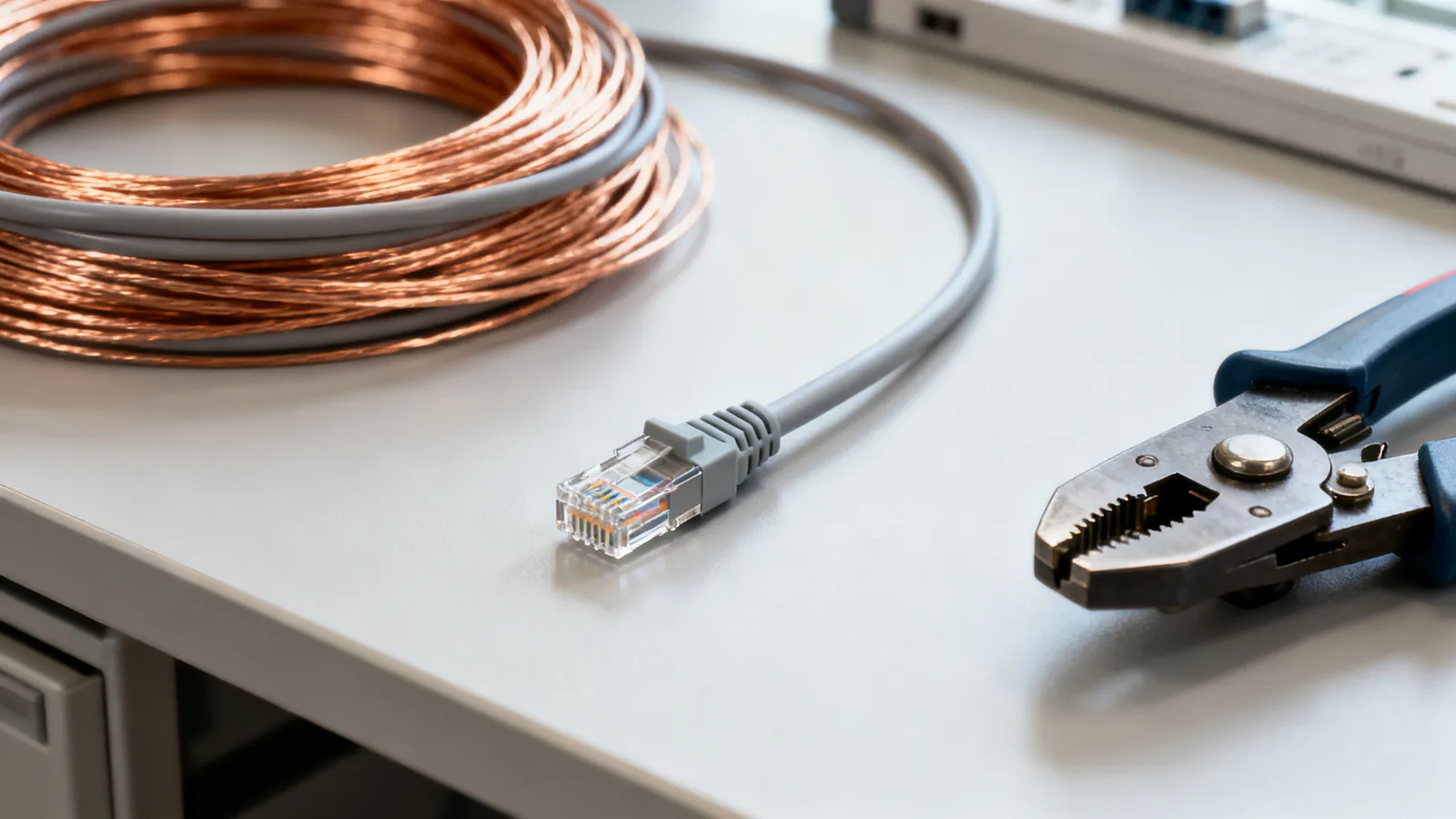
Solid vs stranded Ethernet cable comes down to where the cable lives. Solid copper belongs in the wall, punched into jacks and patch panels, because it carries a signal further and holds a punch-down termination. Stranded copper belongs in patch cords that flex, because it survives repeated bending. Using the wrong one in either place is the most common reason a link fails a certification test or a patch cord dies after a few months of movement.
The conductor inside the jacket
A category cable has four twisted pairs. Each conductor is either one solid copper wire or a bundle of fine copper strands.
Solid conductor: one copper wire per conductor. Lower resistance, better signal performance over distance, and it holds its shape when punched into an insulation displacement contact (IDC) on a jack or panel. It does not tolerate repeated flexing; bend it back and forth enough and the copper work-hardens and cracks.
Stranded conductor: many fine copper strands twisted together. More flexible and more resistant to fatigue, but higher resistance and slightly worse signal performance at high frequency. It is designed for patch cords and equipment cords that get moved.
Both are copper. The difference is mechanical and electrical, not a matter of quality tier.
Which conductor goes where
| Location | Conductor | Why |
|---|---|---|
| Permanent link (horizontal cable in the wall, ceiling, conduit) | Solid copper | Punched into jacks and panels; lower loss over distance |
| Patch cords and equipment cords | Stranded copper | Flexes without cracking; terminated with plugs |
| Patch panel to switch | Stranded patch cord | Moves when equipment changes |
| Wall outlet to device | Stranded patch cord | Moves when furniture or equipment changes |
TIA-568 describes the channel as up to 90 m (295 ft) of permanent link plus up to 10 m (33 ft) of patch and equipment cords, for a total of 100 m (328 ft). The permanent link is the part you install once and leave alone. The patch cords are the part that gets handled.
Gauge: 23 AWG vs 24 AWG and thinner
American Wire Gauge (AWG) is inverse: a lower number is a thicker conductor. Cat5e is commonly 24 AWG, Cat6 is 23 or 24 AWG, and Cat6a is 23 AWG. Patch cords run 24 to 26 AWG, and slim patch cords are 28 AWG, which TIA-568.2-D permits for patch cords.
Thicker conductors have lower resistance. That matters for two reasons:
- Signal loss over distance. A thicker conductor loses less signal, which is why 23 AWG is common in Cat6 and Cat6a.
- Heat under Power over Ethernet. Higher power heats bundled cable. 23 AWG Cat6 or Cat6a copper runs cooler than thinner cable.
A 28 AWG slim patch cord is fine for a short run in a rack where airflow and cable management matter. It is not the right choice for a long permanent link, and it is not the right choice for a high-power PoE device at the end of a long channel.
Why copper-clad aluminium is a false economy
Copper-clad aluminium (CCA) has an aluminium core with a thin copper coating. It is sold as cheaper category cable, and it does not meet TIA category standards.
- Higher resistance than copper, so signal loss is worse and the cable may not reach the distance the category promises.
- Brittle when flexed. The aluminium core cracks where copper would bend.
- More heat under PoE. Aluminium has higher resistance, so more of the power becomes heat in the cable.
Category cable is solid or stranded copper. If a listing says CCA, it is not a category cable in the TIA sense, whatever the jacket printing claims. The same applies to copper-clad steel and other substitutes.
What the category and the channel actually require
The category sets the frequency and the speed. The conductor and the installation decide whether the link meets it. For the full picture of what each category carries, see Ethernet cable categories explained: Cat5e to Cat8.
- Cat5e: rated to 100 MHz; 1000BASE-T (1 Gbps) to 100 m (328 ft); 2.5GBASE-T (2.5 Gbps) to 100 m under IEEE 802.3bz.
- Cat6: rated to 250 MHz; 1 Gbps to 100 m; 10GBASE-T (10 Gbps) up to 55 m (180 ft), and as little as 37 m (121 ft) where many cables run bundled together.
- Cat6a: rated to 500 MHz; 10 Gbps to the full 100 m (328 ft).
A solid copper Cat6a permanent link, terminated properly, is what makes a 10GBASE-T channel possible at 100 m. A stranded patch cord at each end is part of that channel and is allowed, but the cord has to be a real category cord, not a thin untwisted one.
Termination: why solid and stranded need different plugs
RJ45 plugs differ. Plugs for solid conductors and plugs for stranded conductors use different contacts. A plug made for stranded wire may not bite properly into a solid conductor, and a plug made for solid wire may not grip a stranded bundle. Pass-through plugs let the wires run out of the front before crimping, which helps alignment. Shielded cable needs shielded plugs.
TIA recommends factory-made patch cords. The reason is consistency: a factory cord is tested, the crimp is controlled, and the pair untwist is minimal. Field-made cords vary. If you do make your own, the pair untwist at a termination must be no more than 13 mm (0.5 in) for Cat5e and higher. For the step-by-step, see how to crimp an RJ45 connector.
Solid cable is normally punched into jacks and panels, not crimped onto plugs. Stranded cable is normally crimped onto plugs. Mixing the two is where most field failures start.
Installation limits that apply to both
- Installed bend radius for 4-pair UTP: at least 4 times the cable’s outside diameter.
- Maximum pulling tension for 4-pair cable: 25 lbf (110 N).
- Separation from mains: the NEC asks for at least 50 mm (2 in) between communications cable and mains power conductors unless a barrier separates them; cross power cables at a right angle.
- Fire rating: CMP for plenum air-handling spaces, CMR for riser runs between floors, CM or CMG for general purpose, CMX for limited residential use. A higher rating can replace a lower one. For the differences, see plenum vs riser vs CM cable ratings.
- Outdoor cable needs a UV-resistant jacket; direct-burial cable is gel-filled or flooded. Indoor cable is not rated for either.
- Label both ends of every cable, per ANSI/TIA-606.
Mains work is a job for a licensed electrician. Cable selection and termination are not.
What goes wrong
Stranded cable in the wall. It works at first, then the punch-down contact loosens or the strands break at the jack. The link drops to 100 Mbps or fails outright. Use solid copper for permanent links.
Solid cable in a patch cord. It survives a few insertions, then the conductor cracks at the plug. The cord tests fine on a continuity tester and fails when it is moved. Use stranded patch cords.
CCA sold as Cat6. The jacket says Cat6, the conductor is aluminium. The link may negotiate 1 Gbps at short length and fail at longer length, or fail under PoE because the cable heats. CCA does not meet TIA category standards.
28 AWG slim cord on a long PoE run. The cord is fine in a rack. At the end of a long channel feeding a high-power device, the thinner conductor adds loss and heat. Use 23 or 24 AWG for that link.
Untwisted pairs at the termination. More than 13 mm (0.5 in) of untwist raises crosstalk. A continuity tester passes it; a certification tester does not.
A simple continuity tester as proof. Continuity and wiremap testers find opens, shorts, crossed wires and reversed pairs. Split pairs pass a simple continuity test and need a tester that measures crosstalk. Qualification testers check whether a link carries a given speed. Certification testers measure the link against the TIA category limits, which is the only way to prove a link meets Cat6 or Cat6a. A TDR shows the distance to a fault.
Assuming a cable labelled Cat7 with RJ45 plugs is a Cat7 channel. Cat7 is ISO/IEC Class F, rated to 600 MHz, with every pair individually shielded. It is not a TIA category. The standard’s own connectors are GG45 and TERA; Cat7 patch cords with RJ45 plugs are not a standard Cat7 channel and perform as the RJ45 connection allows.
Choosing in practice
For a new permanent link, buy solid copper bulk cable in the category that matches the speed and distance you need. Cat5e solid copper covers 1 Gbps to 100 m. Cat6 solid copper covers 10 Gbps to 55 m (180 ft), or as little as 37 m (121 ft) in a dense bundle. Cat6a solid copper covers 10 Gbps to the full 100 m (328 ft).
For patch cords, buy factory-made stranded cords in the same category as the permanent link. Match the category end to end: a Cat6a permanent link with Cat5e patch cords is a Cat5e channel.
For PoE, use 23 AWG copper in Cat6 or Cat6a where the run is long or the power is high. Never use CCA for PoE.
For a short rack connection where cable density matters, a 28 AWG slim stranded patch cord is permitted and works. Keep it short and keep it out of long PoE runs.
For anything outdoors, use outdoor-rated cable with a UV-resistant jacket, and direct-burial cable if it goes in the ground. Indoor cable is not rated for either.
Common questions
Can I use stranded cable for a permanent in-wall run?
No. Stranded conductors do not hold a punch-down termination reliably and have higher resistance. Use solid copper for the permanent link, and stranded for the patch cords at each end.
Is copper-clad aluminium Ethernet cable any good?
No. CCA has higher resistance, is brittle when flexed, and runs hotter under PoE. It does not meet TIA category standards. Category cable is solid or stranded copper.
What is the difference between 23 AWG and 24 AWG Ethernet cable?
23 AWG has a thicker conductor than 24 AWG. The thicker conductor has lower resistance, so it loses less signal over distance and runs cooler under PoE. Cat6 is commonly 23 or 24 AWG, and Cat6a is commonly 23 AWG.
Can I mix solid and stranded cable in one channel?
Yes, and that is normal. The permanent link is solid copper, and the patch cords at each end are stranded. The channel limit is 100 m (328 ft) total: up to 90 m (295 ft) of permanent link plus up to 10 m (33 ft) of cords.
Why does my patch cord fail after a few months?
A solid-conductor patch cord cracks at the plug when it is flexed. Patch cords should use stranded conductors, which tolerate repeated bending. Factory-made stranded cords are the reliable choice.
Read next
Patch Panels, Keystone Jacks and Wall Plates
A patch panel terminates permanent links in a rack; keystone jacks do the same at the wall. Learn 110 punch down, T568 wiring, labelling and what fails.
T568A vs T568B: Ethernet Wiring Colour Order
T568A and T568B differ only in the orange and green pairs. See both pinouts, which standard to use, and why mixing them makes a crossover cable.
Ethernet Cable Categories: Cat5e to Cat8
Ethernet cable categories compared: Cat5e, Cat6, Cat6a, Cat7 and Cat8 rated frequency, speed and distance, plus which to buy for home, office and 10 Gbps.
Fiber vs Copper Ethernet: When Fiber Makes Sense
Fiber vs copper Ethernet compared: distance, interference, lightning between buildings, speed headroom, and the handling trade-offs against Cat6 and Cat6a.
Fiber Optic Cable Types: Singlemode and Multimode
Singlemode and multimode fiber compared: OS2, OM1 to OM5, jacket colours, reach at 1G, 10G, 40G and 100G, and how to choose for a building or campus.