Fiber Optic Cable Types: Singlemode and Multimode
Singlemode and multimode fiber compared: OS2, OM1 to OM5, jacket colours, reach at 1G, 10G, 40G and 100G, and how to choose for a building or campus.
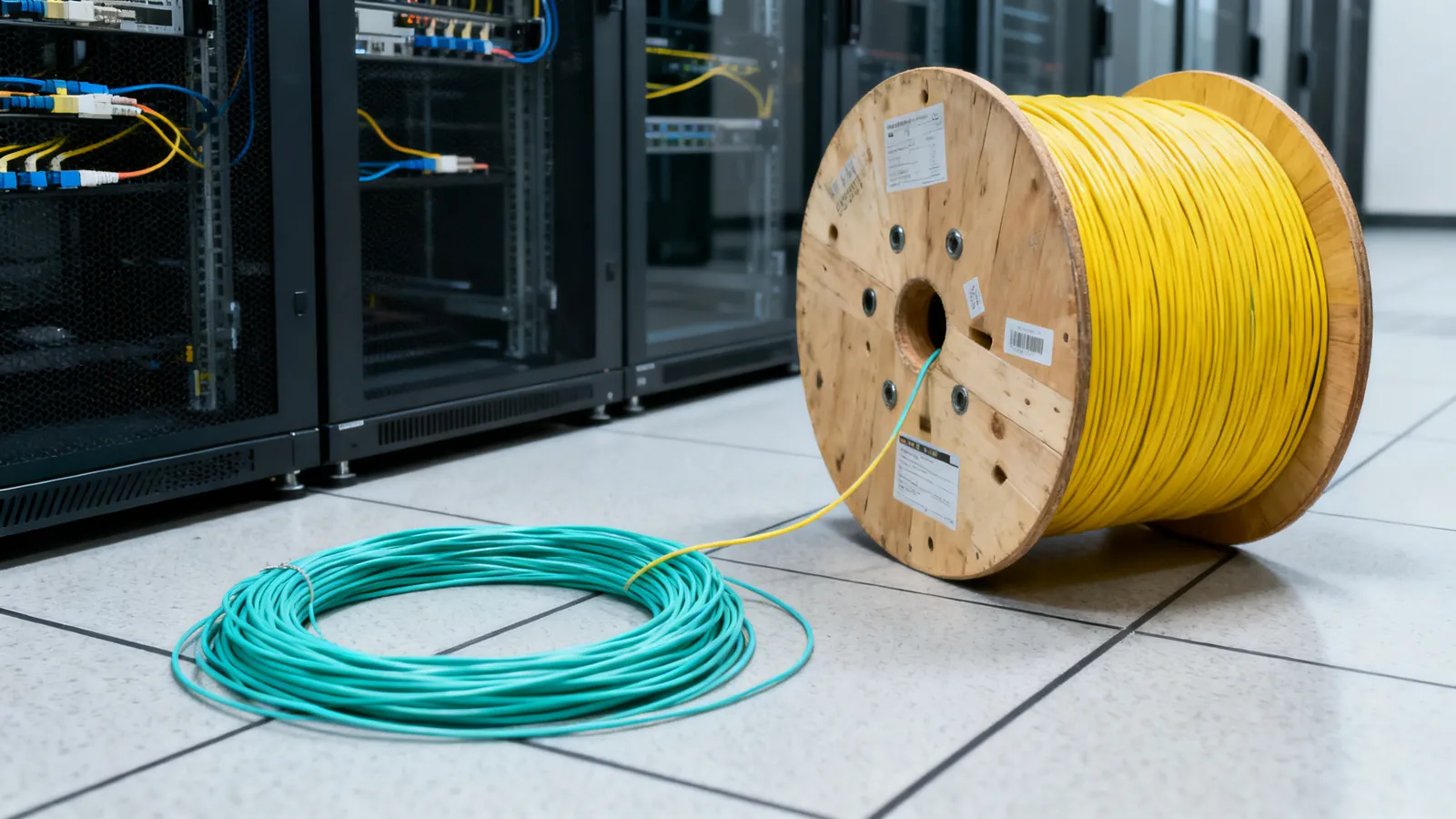
Fiber optic cable carries data as light rather than as electrical pulses, which is why it runs much further than copper and is immune to electrical interference. The two families are singlemode and multimode. Singlemode has a 9 µm core and 125 µm cladding (written 9/125), uses 1310 nm and 1550 nm light, and comes in OS1 and OS2 grades. Multimode has a 50 µm or 62.5 µm core with 125 µm cladding, uses 850 nm (and 1300 nm), and comes in OM1 through OM5. Singlemode reaches kilometres; multimode reaches hundreds of metres. The choice between them is mostly about distance, speed and the cost of the electronics at each end.
Singlemode vs multimode: the core difference
Singlemode fiber has a core so small that light travels in essentially one path. That removes modal dispersion, the spreading of a pulse as different light paths arrive at slightly different times, so the signal stays clean over long distances. Singlemode is used for links between buildings, campus backbones and carrier networks.
Multimode fiber has a larger core that lets many light paths travel at once. It is cheaper to light up because the transceivers use lower-cost light sources, but the pulse spreads sooner, so reach is shorter. Multimode is used inside buildings: floor to floor, rack to rack, and within a data centre.
| Property | Singlemode | Multimode |
|---|---|---|
| Core / cladding | 9/125 µm | 50/125 µm or 62.5/125 µm |
| Wavelengths | 1310 nm, 1550 nm | 850 nm, 1300 nm |
| Grades | OS1, OS2 | OM1, OM2, OM3, OM4, OM5 |
| Jacket colour | Yellow | Orange, aqua, violet, lime green |
| Typical reach | 10 km and beyond | Up to 400 m at 10G |
| Typical use | Campus, building-to-building | In-building, data centre |
The multimode grades and their jacket colours
Multimode is graded by bandwidth and by how well it works with laser sources. The grade is printed on the jacket, and the jacket colour is a quick visual clue.
- OM1: 62.5 µm core, orange jacket. Older installs.
- OM2: 50 µm core, orange jacket.
- OM3: 50 µm laser-optimised, aqua jacket.
- OM4: 50 µm, aqua jacket (sometimes violet).
- OM5: 50 µm wideband (850-953 nm), lime green jacket.
Singlemode is yellow. If you are looking at an unknown cable, the colour tells you the family and often the grade. For a full comparison of the multimode grades, see OM1, OM2, OM3, OM4 and OM5 multimode fiber compared.
Reach at common speeds
The distance a fiber link will carry depends on the grade, the wavelength and the transceiver. The figures below are the standard reaches for the common Ethernet types.
| Speed and type | Fiber grade | Reach |
|---|---|---|
| 1000BASE-SX | OM1 | 275 m (902 ft) |
| 1000BASE-SX | OM2 | 550 m (1804 ft) |
| 10GBASE-SR | OM1 | 33 m |
| 10GBASE-SR | OM2 | 82 m |
| 10GBASE-SR | OM3 | 300 m (984 ft) |
| 10GBASE-SR | OM4 | 400 m (1312 ft) |
| 10GBASE-SR | OM5 | 400 m |
| 40GBASE-SR4 | OM3 | 100 m |
| 40GBASE-SR4 | OM4 | 150 m |
| 100GBASE-SR4 | OM3 | 70 m |
| 100GBASE-SR4 | OM4 | 100 m |
| 10GBASE-LR | Singlemode | 10 km (about 6 miles) |
| 10GBASE-ER | Singlemode | 40 km |
For a run inside a building, OM3 or OM4 usually covers the distance at 10G and beyond. For a link between buildings, singlemode is the normal choice because it covers the distance without repeaters and is not affected by ground-potential differences or lightning surges between buildings.
Connectors and polish
Fiber connectors are chosen for the port and the patch panel. LC has a 1.25 mm ferrule and is the usual connector on SFP modules. SC has a 2.5 mm ferrule and a push-pull body. ST has a 2.5 mm ferrule and a twist-lock bayonet, and is older. MPO/MTP holds 12 or 24 fibers in one ferrule for 40G and 100G parallel optics.
Polish matters. UPC connectors have a blue body and a flat end face. APC connectors have a green body and an 8-degree angled end face. Never mate an APC connector with a UPC one: the faces do not meet, and the link fails or the connectors are damaged. For more on connector types and polish, see fiber connector types: LC, SC, ST and MPO, UPC vs APC.
Choosing fiber for a building, a campus and between buildings
Inside a single building, multimode is usually the practical choice. OM3 or OM4 supports 10G to 300 m or 400 m and 40G/100G over shorter runs, and the transceivers cost less than singlemode equivalents. Use aqua OM3 or OM4 for new in-building work; OM1 and OM2 are older and limit 10G to 33 m or 82 m.
For a campus, where links run between buildings, singlemode is the standard. OS2 is the grade for longer outdoor runs. Singlemode transceivers reach 10 km at 10GBASE-LR and 40 km at 10GBASE-ER, so a campus ring or a link to a distant building is covered without intermediate equipment.
Between buildings, the cable itself must be outdoor-rated. Indoor cable is not rated for UV exposure or for direct burial. Outdoor cable needs a UV-resistant jacket, and direct-burial cable is gel-filled or flooded to keep water out. If the run enters a building, the cable must transition to an indoor-rated type at the entry point.
At the ends of the link, the transceiver must match the fiber and the speed. SFP is 1 Gbps, SFP+ is 10 Gbps, SFP28 is 25 Gbps, QSFP+ is 40 Gbps and QSFP28 is 100 Gbps. For short links within a rack, a DAC (direct attach copper) cable joins two SFP ports without separate optics; passive SFP+ DAC cables run up to 7 m. An AOC (active optical cable) is a fixed fiber cable with transceivers built in, for longer runs. For more on modules and cables, see SFP and SFP+ modules, DAC and AOC cables.
What goes wrong
The most common mistakes with fiber are grade and polish mismatches, dirty connectors, and bending the cable too tightly.
- APC mated with UPC. The angled face and the flat face do not meet. The link fails or the connectors are damaged. Check the connector body colour: blue is UPC, green is APC.
- Wrong grade for the distance. OM1 at 10GBASE-SR reaches 33 m, OM2 reaches 82 m. A run planned for 100 m on OM1 will not work. Check the grade printed on the jacket before ordering transceivers.
- Dirty end faces. A speck of dust on a fiber end face blocks or scatters light. Clean and inspect every connector before mating it.
- Tight bends. Fiber has a minimum bend radius. A sharp bend causes loss or a crack. Follow the cable manufacturer’s bend radius.
- Mismatched transceiver and fiber. A singlemode transceiver needs singlemode fiber; a multimode transceiver needs multimode fiber. The two are not interchangeable.
- Indoor cable used outdoors. Indoor cable is not UV-resistant and not flooded for direct burial. It will degrade or take in water.
- Wrong connector for the port. LC, SC and ST do not mate with each other. MPO/MTP is for parallel optics and is not an LC substitute.
Fiber carries no electricity, so it is immune to electrical interference and to ground-potential differences and lightning surges between buildings. That is a large part of why it is used for links between buildings rather than copper.
A note on testing
A continuity tester will show that light passes, but it will not prove that a link meets a standard. Certification testers measure the link against the limits for the fiber type, including insertion loss and return loss. A TDR or OTDR shows the distance to a fault. For a new install, test and document every link; label both ends of every cable.
Common questions
What is the difference between singlemode and multimode fiber?
Singlemode has a 9 µm core and carries light in one path, so it reaches kilometres. Multimode has a 50 µm or 62.5 µm core and carries many light paths, so it reaches hundreds of metres. Singlemode is used between buildings; multimode is used inside buildings.
What do the fiber cable colors mean?
Yellow is singlemode. Orange is OM1 or OM2 multimode. Aqua is OM3 or OM4. Lime green is OM5. Violet is sometimes used for OM4. The colour is a quick clue, but the grade is printed on the jacket.
How far can multimode fiber run at 10G?
10GBASE-SR reaches 33 m on OM1, 82 m on OM2, 300 m on OM3 and 400 m on OM4 or OM5. The grade and the transceiver both set the limit.
Can I use singlemode transceivers on multimode fiber?
No. A singlemode transceiver needs singlemode fiber and a multimode transceiver needs multimode fiber. The core sizes and wavelengths do not match, and the link will not work.
What is the difference between UPC and APC connectors?
UPC has a flat end face and a blue body. APC has an 8-degree angled end face and a green body. They must not be mated together, because the faces do not meet and the link fails or the connectors are damaged.
Read next
Fiber Connector Types: LC, SC, ST, MPO, UPC vs APC
Compare LC, SC, ST and MPO fiber connectors, and learn why UPC and APC polish must never be mated. Includes cleaning and selection advice.
Multimode Fiber Grades Compared: OM1 to OM5
Compare OM1 to OM5 multimode fiber: core size, jacket colour, and 1G, 10G, 40G and 100G reach. See what to install new and what old OM1 and OM2 still carry.
SFP vs SFP+: Modules, DAC and AOC Cables
SFP vs SFP+: how the module family scales from 1G to 100G, which fiber each type needs, when to use DAC or AOC cables, and why vendor coding matters.