Multimode Fiber Grades Compared: OM1 to OM5
Compare OM1 to OM5 multimode fiber: core size, jacket colour, and 1G, 10G, 40G and 100G reach. See what to install new and what old OM1 and OM2 still carry.
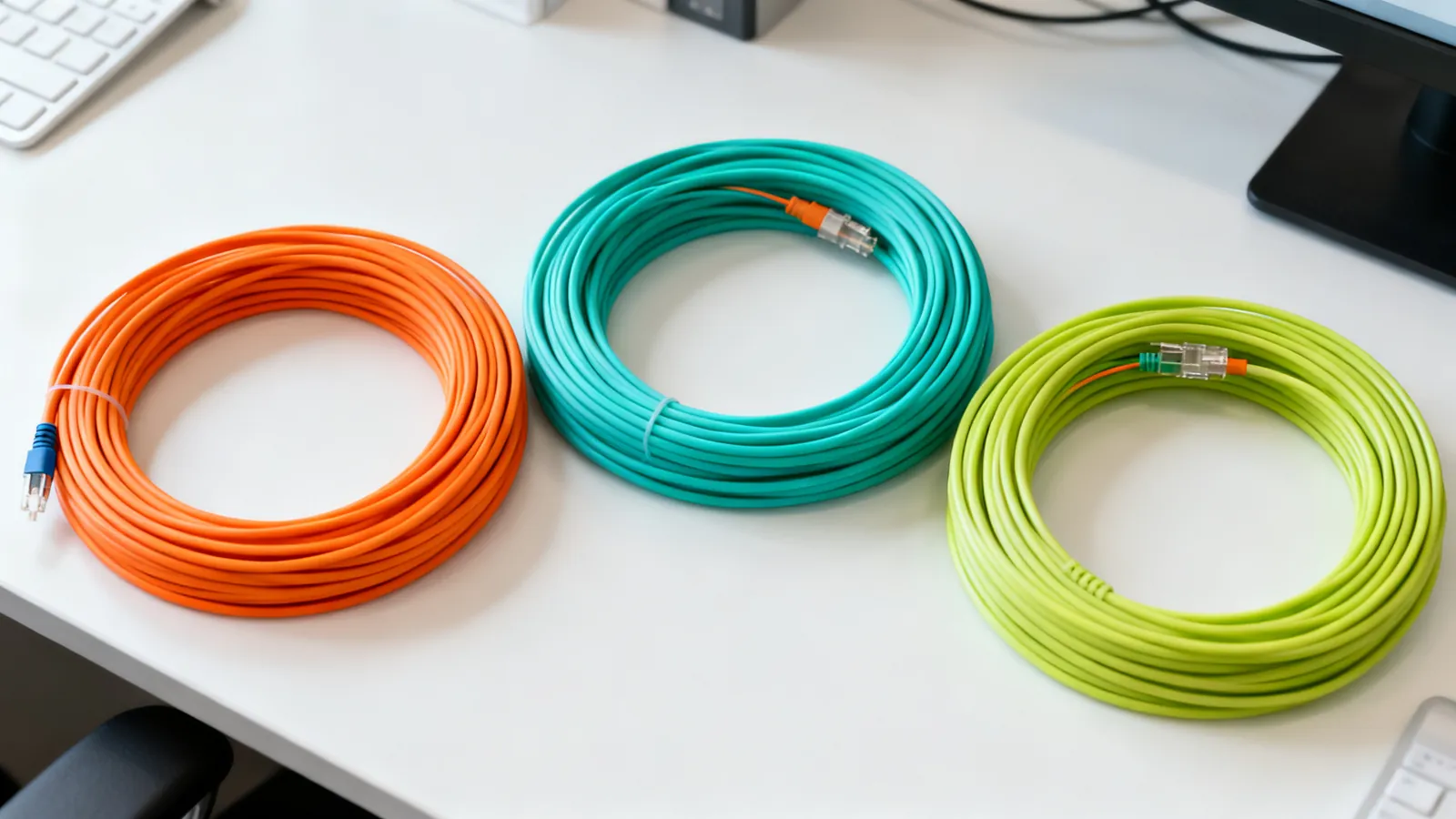
Multimode fiber is the short-reach choice: a glass core wide enough to accept light from a low-cost LED or VCSEL source, used over distances from a few tens of metres to a few hundred. The grade you have — OM1, OM2, OM3, OM4 or OM5 — decides which speeds it will carry and how far. The table below gives the reach figures for the common Ethernet rates, and the rest of the page explains what those numbers mean when you are standing in front of a patch panel.
The grades at a glance
| Grade | Core / cladding | Jacket colour | 1000BASE-SX | 10GBASE-SR | 40GBASE-SR4 | 100GBASE-SR4 |
|---|---|---|---|---|---|---|
| OM1 | 62.5/125 µm | Orange | 275 m (902 ft) | 33 m | — | — |
| OM2 | 50/125 µm | Orange | 550 m (1804 ft) | 82 m | — | — |
| OM3 | 50/125 µm, laser-optimised | Aqua | — | 300 m (984 ft) | 100 m | 70 m |
| OM4 | 50/125 µm | Aqua (sometimes violet) | — | 400 m (1312 ft) | 150 m | 100 m |
| OM5 | 50/125 µm, wideband | Lime green | — | 400 m | — | — |
A dash means the grade is not specified for that rate. The 1000BASE-SX figures are the standard’s reach over each grade; OM3 and OM4 also run 1000BASE-SX, comfortably within their 10G distances.
OM1 and OM2 are legacy. OM1 has a 62.5 µm core; OM2 moved to 50 µm. Both were designed around LED sources and lower bit rates. OM3 was the first grade optimised for 850 nm VCSELs, which is why its 10G reach jumps to 300 m (984 ft) while OM2 manages only 82 m. OM4 is a further refinement of the same 50 µm core, pushing 10G to 400 m (1312 ft) and 100G to 100 m. OM5 is a wideband grade specified from 850 to 953 nm, intended for short-wavelength division multiplexing; for plain 10GBASE-SR it matches OM4 at 400 m.
What the reach numbers actually depend on
Two things set the distance: the launch condition of the light and the modal bandwidth of the fiber. A VCSEL launches light into a small spot, which excites fewer modes and travels further than an LED’s broad launch. That is why the same 50 µm glass gives 550 m at 1G on OM2 but only 82 m at 10G — the higher rate uses a tighter, faster modulation that tolerates less dispersion.
For 40G and 100G, the link uses parallel optics: four or ten lanes over an MPO/MTP connector with 12 or 24 fibers in one ferrule. That is why 40GBASE-SR4 and 100GBASE-SR4 appear only against OM3 and OM4 — the grades with enough bandwidth to carry multiple lanes at those rates over useful distances. The reach figures assume a clean, well-terminated link; every mated pair, splice and bend adds loss.
Which grade to install new
For a new installation, OM4 is the practical default. It covers 10G to 400 m (1312 ft), 40G to 150 m and 100G to 100 m, and it is widely stocked in both LC and MPO assemblies. OM3 is still perfectly serviceable for 10G to 300 m (984 ft) and is often already in place; if a run is short and the budget is tight, OM3 will do the job. OM5 costs more and buys nothing for standard 10G, 40G or 100G Ethernet — its advantage appears only when you multiplex several wavelengths over one pair, which most campus and in-building links do not do.
Singlemode is the other option, and for runs beyond a few hundred metres it is the only one. The trade-off is cost: singlemode transceivers and the tighter tolerances of 9 µm core work cost more than multimode. The full picture of when to choose each is in fiber optic cable types.
Connectors and polish
Multimode patch cords almost always use LC connectors (1.25 mm ferrule), which is what SFP and SFP+ modules accept. SC (2.5 mm ferrule, push-pull) and ST (2.5 mm, twist-lock bayonet) appear on older installations. MPO/MTP is used for 40G and 100G parallel links.
Polish matters: UPC connectors have a blue body, APC a green body with an 8-degree angled end face. Never mate an APC connector with a UPC one — the faces do not meet and the link fails or the connectors are damaged. Multimode is normally UPC.
What existing OM1 and OM2 can still carry
OM1 and OM2 are not dead, but they are limited. At 1G they run 275 m and 550 m respectively, which covers most in-building runs. At 10G, OM1 reaches only 33 m and OM2 82 m — fine for a short link inside a rack or between adjacent cabinets, not for a floor-to-floor run. Neither grade is specified for 40G or 100G.
If you have OM1 or OM2 in the walls and need 10G, measure the actual run before assuming it will work. If it is under the limit for the grade, 10GBASE-SR modules will light it up. If it is longer, the options are to pull new OM4, or to use a copper or active optical alternative for the link. The modules and direct-attach cables that plug into these ports are covered in SFP and SFP+ modules, DAC and AOC cables.
What goes wrong
Mismatched grades in one link. Joining OM1 to OM3 with a patch cord works electrically, but the link performs to the worst grade in the path. A 10G run that is OM3 in the wall and OM1 at one end is an OM1 link.
APC mated to UPC. The angled face and the flat face do not meet. The link either fails outright or the connectors are damaged. Check the body colour before mating.
Dirty or scratched end faces. A single speck of dust on a 50 µm core blocks a large fraction of the light. Inspect and clean every connector before mating; this is the most common cause of a link that tests bad.
Tight bends. Fiber has a minimum bend radius, and a kink causes loss or a break. Route with gentle curves and use bend-insensitive cord where space is tight.
Assuming OM5 helps 10G. It does not. OM5 reaches the same 400 m as OM4 at 10GBASE-SR. Its wideband window only matters for short-wavelength multiplexing.
Forgetting the transceiver. The fiber grade sets the distance, but the module must match the rate and the fiber. A 10GBASE-SR module expects multimode; a 10GBASE-LR module expects singlemode and will not work over multimode. Switch vendors may also accept only modules coded for their equipment.
Choosing between OM3 and OM4
The question of OM3 vs OM4 comes down to distance and headroom. OM3 gives 10G to 300 m (984 ft); OM4 gives 400 m (1312 ft) and doubles the 40G reach from 100 m to 150 m. If your longest run is comfortably under 300 m and you are not planning 40G or 100G, OM3 is adequate. If you are near the limit, or want room for a future upgrade to 40G or 100G, OM4 is the safer choice and the price difference is small relative to the cost of pulling new cable.
For OM4 vs OM5, the answer is simpler: unless you are deploying short-wavelength multiplexing, OM4 does everything OM5 does for standard Ethernet rates. OM5 is a specialised grade, not a general upgrade.
A note on singlemode
Singlemode fiber has a 9 µm core and carries 10GBASE-LR to 10 km (about 6 miles) and 10GBASE-ER to 40 km. It is immune to the modal dispersion that limits multimode, so it scales to any rate the transceiver supports. For runs beyond a few hundred metres, or for links between buildings, it is the correct choice. Multimode wins on cost for the short runs inside a building or data hall.
Common questions
What is the difference between OM3 and OM4?
Both use a 50 µm core and aqua jacket. OM4 has higher modal bandwidth, so 10GBASE-SR reaches 400 m (1312 ft) instead of 300 m (984 ft), and 40GBASE-SR4 reaches 150 m instead of 100 m. OM4 is the better choice for new installations.
Can I run 10G over OM1 or OM2 fiber?
Yes, but only over short distances. 10GBASE-SR reaches 33 m on OM1 and 82 m on OM2. Neither grade is specified for 40G or 100G. Measure the run before assuming it will work.
Is OM5 better than OM4?
For standard Ethernet rates, no. OM5 reaches the same 400 m at 10GBASE-SR as OM4. Its advantage is a wider wavelength window (850–953 nm) for short-wavelength multiplexing, which most links do not use.
How do I tell the grades apart?
By jacket colour and printing. OM1 and OM2 are orange, OM3 and OM4 are aqua (OM4 sometimes violet), and OM5 is lime green. The grade is usually printed on the jacket.
What connector do multimode links use?
LC is the usual connector on SFP and SFP+ modules. Older installations may use SC or ST. 40G and 100G parallel links use MPO/MTP connectors with 12 or 24 fibers.
Read next
Fiber Connector Types: LC, SC, ST, MPO, UPC vs APC
Compare LC, SC, ST and MPO fiber connectors, and learn why UPC and APC polish must never be mated. Includes cleaning and selection advice.
Fiber Optic Cable Types: Singlemode and Multimode
Singlemode and multimode fiber compared: OS2, OM1 to OM5, jacket colours, reach at 1G, 10G, 40G and 100G, and how to choose for a building or campus.
SFP vs SFP+: Modules, DAC and AOC Cables
SFP vs SFP+: how the module family scales from 1G to 100G, which fiber each type needs, when to use DAC or AOC cables, and why vendor coding matters.