Plenum vs Riser vs CM Cable Ratings
CMP, CMR, CM and CMX explained: where each US fire rating is required, the EU CPR classes, and what to use outdoors or underground.
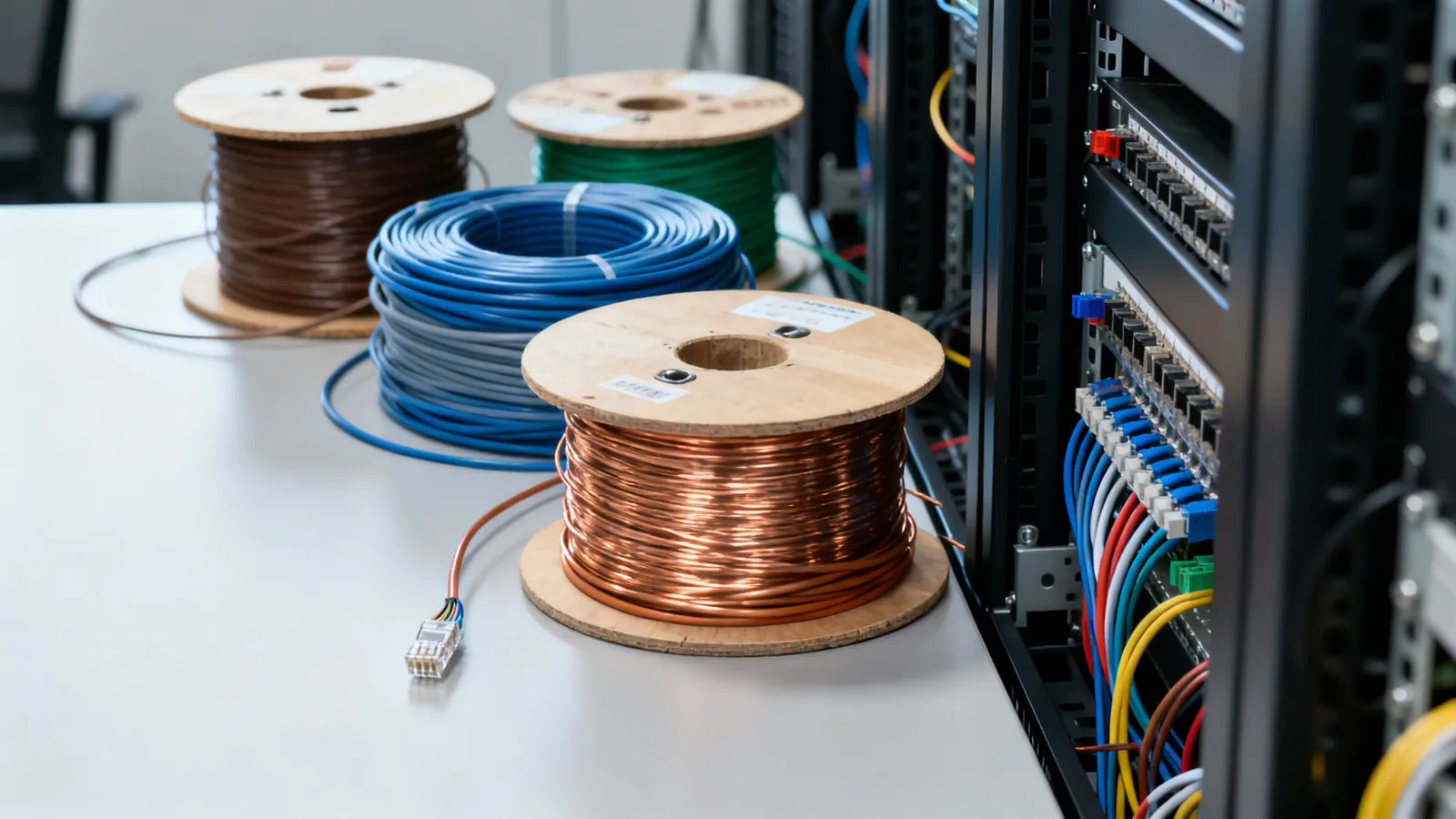
A cable’s fire rating decides where you are allowed to install it. In the US, the National Electrical Code (NEC) sorts communications cable into four levels: CMP (plenum), CMR (riser), CM or CMG (general purpose) and CMX (limited residential use). A higher rating can replace a lower one, so CMP can go anywhere CMR can, and CMR can go anywhere CM can. The rating has nothing to do with speed, category or shielding: a Cat6 cable comes in CMP, CMR and CM versions, and all three carry the same signal.
What each US rating means
| Rating | Where the NEC allows it | Typical jacket |
|---|---|---|
| CMP | Plenum: air-handling spaces above suspended ceilings and under raised floors | Low-smoke, often fluorinated |
| CMR | Riser: vertical shafts between floors | PVC-based |
| CM / CMG | General purpose: horizontal runs inside a room or floor | PVC-based |
| CMX | Limited residential use, often outdoors or in conduit | Weather-resistant |
The logic is simple. A plenum space is part of the building’s air circulation: if cable burns there, smoke and fumes travel through the whole floor. CMP cable is tested for flame spread and smoke production in that exact setting, which is why it costs more and why inspectors look for it. A riser shaft is a vertical chimney between floors, so CMR cable is tested for flame spread up a vertical tray. General-purpose CM cable is for horizontal runs where a fire would be contained by the room.
If you are unsure which space you have, look at how the ceiling is built. A suspended ceiling with a return-air plenum above it is a plenum space; a sealed ceiling with ducted return air is not. When in doubt, CMP is the safe choice because it satisfies every lower requirement.
The EU equivalent: CPR Euroclasses
In the European Union, cable fire performance is classed under the Construction Products Regulation (CPR), with Euroclasses such as Eca, Dca, Cca and B2ca. The letters run from lower to higher performance, and the class is declared on the cable and in the manufacturer’s declaration of performance. LSZH (low smoke zero halogen) jackets are common in the EU and are often specified alongside a CPR class. There is no direct one-to-one mapping between a US rating and a Euroclass: a project in the EU is specified by Euroclass, a project in the US by NEC rating, and a cable carrying both markings has been tested to both schemes.
Outdoor and direct-burial cable
Outdoor cable needs a UV-resistant jacket, because sunlight destroys ordinary PVC over a few seasons. Direct-burial cable is gel-filled or flooded to keep water out of the core; indoor cable is rated for neither sunlight nor moisture, and burying it will fail. If the run leaves the building, fibre is often the better answer because it carries no electricity and is immune to ground-potential differences and lightning surges between buildings.
CMX is the rating you will see on cable sold for outdoor and limited residential use. It is not a substitute for CMP or CMR indoors: CMX is a lower rating, so it cannot replace CM, CMR or CMP in a plenum or riser. Run outdoor-rated cable outside, transition to an indoor rating at the point of entry, and keep the transition inside a proper box.
Which rating to buy for a normal install
For a house or small office, the practical rules are:
- Horizontal runs inside a room or above a drop ceiling with no air handling: CM or CMG is enough.
- Vertical runs between floors: CMR.
- Any air-handling plenum: CMP.
- Outdoors or in a wet location: outdoor-rated, UV-resistant jacket; direct-burial if it goes in the ground.
- Inside a wall next to mains power: keep at least 50 mm (2 in) between communications cable and mains conductors unless a barrier separates them, and cross power cables at a right angle. Mains work itself is a job for a licensed electrician.
If you are planning the whole run, the choices interact: the jacket rating, the conductor type and the route all have to line up. A short guide to planning a wired home network covers how the horizontal link, patch panel and outlets fit together.
Conductors, shielding and the rating are separate questions
The fire rating says nothing about whether the cable is solid or stranded, shielded or unshielded. Horizontal cable in a wall is solid copper so it can be punched into jacks and panels; patch cords are stranded so they flex. The difference matters when you terminate: solid cable takes a punch-down block, stranded takes a plug. If you are choosing between the two, solid vs stranded Ethernet cable explains where each belongs.
Shielding is a third, separate choice. A shielded system needs shielded jacks, plugs and patch panels, and grounding through the equipment; a shield that is broken or not grounded gives no benefit and can pick up noise. The jacket rating does not change any of that.
What goes wrong
- Using CMX indoors in a plenum or riser. CMX is a lower rating and cannot replace CM, CMR or CMP. An inspector will fail it, and the cable is not tested for the smoke behaviour the space requires.
- Assuming CMP is only about fire. CMP cable is stiffer and less flexible than CM, and its jacket is harder to strip. It is also usually thicker, which changes how many cables fit in a conduit or tray.
- Buying CCA and expecting a category rating. Copper-clad aluminium conductors do not meet TIA category standards: higher resistance, brittle when flexed, more heat under PoE. Category cable is solid or stranded copper.
- Running indoor cable outdoors or underground. Sunlight and moisture destroy it. Outdoor cable needs a UV-resistant jacket; direct-burial cable is gel-filled or flooded.
- Forgetting the 100 m channel limit. The rating does not extend distance. The channel is 100 m (328 ft) in total: up to 90 m (295 ft) of permanent link plus up to 10 m (33 ft) of patch and equipment cords. That applies to every speed from 10 Mbps to 10 Gbps on the matching category.
- Mixing ratings in one run without a transition. If you change from outdoor to indoor cable, do it at a proper entry point, not in the middle of a ceiling void.
- Ignoring the bend radius and pulling tension. Installed bend radius for 4-pair UTP is at least 4 times the cable’s outside diameter, and maximum pulling tension is 25 lbf (110 N). A kinked CMP cable is still a failed link.
- Assuming a higher rating means a faster cable. It does not. Cat5e is rated to 100 MHz and carries 1000BASE-T to 100 m; Cat6 is rated to 250 MHz and carries 10GBASE-T up to 55 m (180 ft), and as little as 37 m (121 ft) where many cables run bundled together. The jacket rating is a fire question, not a bandwidth question.
Termination and testing notes
Pair untwist at a termination should be no more than 13 mm (0.5 in) for Cat5e and higher. Label both ends of every cable; ANSI/TIA-606 is the labelling standard. A continuity tester finds opens, shorts, crossed wires and reversed pairs, but split pairs pass a simple continuity test and need a tester that measures crosstalk. Only a certification tester can prove a link meets Cat6 or Cat6a limits. A TDR shows the distance to a fault, which is useful when a plenum run has been damaged during construction.
If the cable is going to carry power as well as data, remember that PoE keeps the 100 m (328 ft) Ethernet limit, and that higher power heats bundled cable. 23 AWG Cat6/Cat6a copper runs cooler than thinner cable, and CCA should never carry PoE. The jacket rating does not change that calculation.
Common questions
Can I use riser cable in a plenum ceiling?
No. CMR is rated for vertical riser shafts, not air-handling plenum spaces. A plenum space needs CMP cable, which is tested for flame spread and smoke production in that setting. CMP can replace CMR, but not the other way round.
What is CMX cable used for?
CMX is the NEC's limited residential rating, commonly used for outdoor and limited indoor runs. It is a lower rating than CM, CMR or CMP, so it cannot replace them in a plenum or riser. Outdoor cable also needs a UV-resistant jacket.
Do I need direct-burial Ethernet cable underground?
Yes. Direct-burial cable is gel-filled or flooded to keep water out of the core, and it has a jacket rated for the ground. Ordinary indoor cable is not rated for moisture or sunlight and will fail if buried. If the run leaves the building, fibre is often the better choice because it carries no electricity.
Does the fire rating affect speed or category?
No. CMP, CMR, CM and CMX are fire ratings, not performance ratings. A Cat6 cable in CMP and a Cat6 cable in CMR carry the same signal. Category and distance limits are set by the cable's electrical performance, not its jacket.
What is the EU equivalent of plenum and riser ratings?
The EU classes cable fire performance under the Construction Products Regulation (CPR), with Euroclasses such as Eca, Dca, Cca and B2ca. There is no direct one-to-one mapping to US ratings, so a project in the EU is specified by Euroclass and a project in the US by NEC rating.
Read next
Cat5e vs Cat6 vs Cat6a: Which Ethernet Cable to Buy
Cat5e, Cat6 and Cat6a compared: bandwidth, 10 Gbps reach, shielding and when each category is the right choice for home or office cabling.
Cat7 and Cat8 Cables: What They Are and Who Needs Them
Cat7 is ISO-only with GG45 or TERA connectors; Cat8 is a 30 m data-centre cable. Learn what each standard says and what to buy for home or office.
Ethernet Cable Categories: Cat5e to Cat8
Ethernet cable categories compared: Cat5e, Cat6, Cat6a, Cat7 and Cat8 rated frequency, speed and distance, plus which to buy for home, office and 10 Gbps.