Ethernet Cable Testers: What Each Kind Checks
Continuity, qualification and certification testers compared: what each checks, why a cheap tester misses split pairs, and how to read the results.
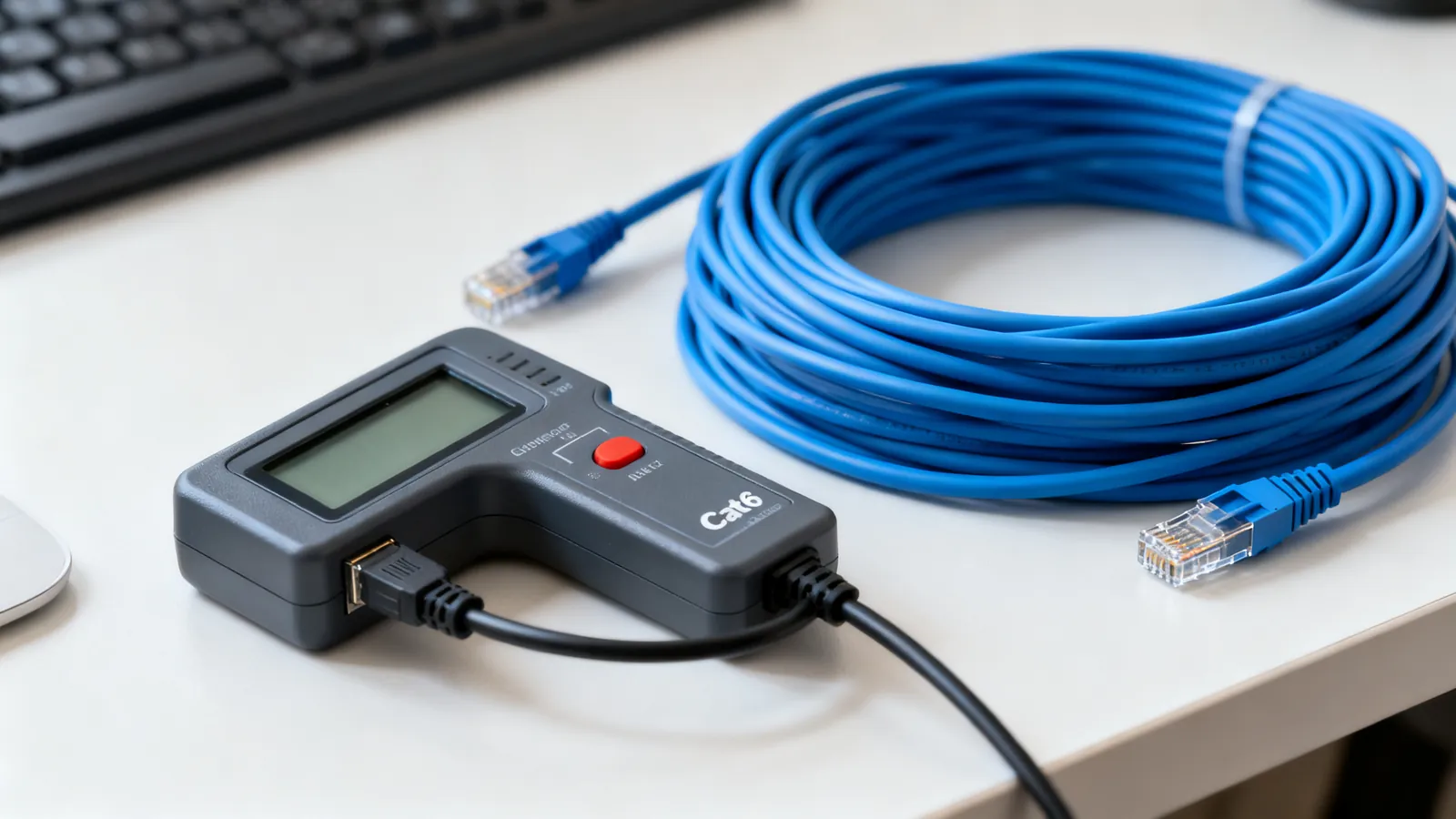
An Ethernet cable tester is not one instrument. The name covers everything from a continuity checker that lights up eight LEDs to a certification tester that measures a link against the TIA category limits. What separates them is what they can prove: a continuity tester proves wires go where they should, a qualification tester proves a link carries a given speed, and only a certification tester proves a link meets Cat6 or Cat6a. Choosing the wrong one means passing a cable that will not run the speed you need.
Continuity and wiremap testers
A wiremap tester checks that each pin at one end connects to the correct pin at the other. It finds opens (a broken conductor), shorts (two conductors touching), crossed wires and reversed pairs. Most show eight LEDs or a small screen with the pin order at each end.
This is the tool for a patch cord you have just made or a run you have just terminated. It confirms the pinout matches the scheme you intended. If you are terminating plugs yourself, the pin order matters: see how to crimp an RJ45 connector for the sequence, and T568A vs T568B for which colour order to use at both ends.
What a wiremap tester cannot see is a split pair. A split pair is a wiring fault where the tip conductor of one pair is terminated with the ring conductor of another pair. The signal still has continuity from end to end, so a basic tester shows a pass. But the signal is now travelling on two conductors that are not twisted together, so crosstalk rises sharply and the link fails at speed. Finding a split pair needs a tester that measures crosstalk, not just continuity.
What a basic tester will and will not find
| Fault | Continuity tester | Tester with crosstalk |
|---|---|---|
| Open conductor | Yes | Yes |
| Short between conductors | Yes | Yes |
| Crossed or reversed pair | Yes | Yes |
| Split pair | No | Yes |
| Excessive crosstalk | No | Yes |
| Return loss / impedance faults | No | Sometimes |
Qualification testers
A qualification tester answers a different question: will this link carry the speed I need? It applies a signal and checks whether the link supports a given Ethernet rate, such as 1000BASE-T (1 Gbps) or 10GBASE-T (10 Gbps). It does not measure against the full TIA category limits, so it cannot certify a link, but it is faster and cheaper than a certifier and is often enough when you are checking whether an existing run will work.
Qualification is useful when you inherit cabling and do not know its category, or when you have made a change and want to confirm the link still carries the intended speed. It is not a substitute for certification on a new installation where the contract or the client requires proof.
Certification testers
A certification tester measures the link against the TIA category limits: insertion loss, near-end crosstalk (NEXT) and return loss, among others. It is the only instrument that can prove a link meets Cat6 or Cat6a. The tester stores results, often with the cable ID, and produces a report.
Certification matters because the category limits are what the standard defines, not what a particular speed needs on a good day. A link that passes a continuity test and runs 1 Gbps may still fail the Cat6 limits and be unable to run 10GBASE-T to 55 m (180 ft). The certifier tells you which side of the line you are on.
Category limits a certifier checks against
| Category | Rated frequency | 10GBASE-T reach |
|---|---|---|
| Cat5e | 100 MHz | Not specified |
| Cat6 | 250 MHz | 55 m (180 ft), as little as 37 m (121 ft) bundled |
| Cat6a | 500 MHz | 100 m (328 ft) |
| Cat8 | 2000 MHz | 30 m (98 ft) channel, two connectors |
A certifier set to Cat6a will fail a link that only meets Cat6. That is the point: the test is against the category you specify, not against the speed you hope for.
Reading the results
A wiremap result shows the pin order at each end. Compare it with the scheme you used. T568A pin order is 1 white/green, 2 green, 3 white/orange, 4 blue, 5 white/blue, 6 orange, 7 white/brown, 8 brown. T568B is 1 white/orange, 2 orange, 3 white/green, 4 blue, 5 white/blue, 6 green, 7 white/brown, 8 brown. The two differ only in swapping the orange and green pairs. Both work identically, but use one scheme at both ends of every cable in a building.
A length reading comes from a TDR (time domain reflectometer) built into the tester. It shows the distance to a fault, which is what you need when a run fails and you have to find where. A certifier reports pass or fail against each limit, with margin. A link that passes with little margin may still be sensitive to temperature or to changes in the bundle.
What the numbers mean
- Insertion loss: signal lost along the cable. Rises with length and frequency.
- NEXT: signal coupled from one pair to another at the near end. The main limit on higher speeds.
- Return loss: signal reflected back by impedance changes, such as a bad termination or a tight bend.
- Split pair: a wiring fault that shows as high crosstalk, not as a continuity failure.
What goes wrong
A continuity tester passing a cable does not mean the cable will run the speed you need. The most common mistake is trusting a basic tester on a link that then fails at 10GBASE-T. The fault is usually a split pair, a termination with too much pair untwist, or a bend tighter than the cable allows.
Pair untwist at a termination must be no more than 13 mm (0.5 in) for Cat5e and higher. More than that raises crosstalk and can fail a certifier even though the wiremap is correct. The installed bend radius for 4-pair UTP is at least 4 times the cable’s outside diameter. Maximum pulling tension is 25 lbf (110 N). A cable pulled too hard or bent too tight can pass a continuity test and fail at speed.
Copper-clad aluminium (CCA) conductors do not meet TIA category standards. They have higher resistance, are brittle when flexed and run hotter under PoE. A certifier will fail them, and a continuity tester may pass them. Category cable is solid or stranded copper.
A shielded system needs shielded jacks, plugs and patch panels, and grounding through the equipment. A shield that is broken or not grounded gives no benefit and can pick up noise. A certifier on a shielded link checks the shield continuity as part of the test.
Separation from mains matters. The NEC asks for at least 50 mm (2 in) between communications cable and mains power conductors unless a barrier separates them, and power cables should cross at a right angle. A link that passes on the bench can fail in the wall if it runs alongside mains cable. Mains work is a job for a licensed electrician.
Choosing a tester
For a patch cord or a single run you have just terminated, a continuity and wiremap tester is enough. It confirms the pinout and finds opens and shorts. It will not find a split pair.
For checking whether an existing link will carry a given speed, a qualification tester is the practical choice. It is faster than a certifier and does not need the full category test setup.
For a new installation where you must prove the link meets Cat6 or Cat6a, a certification tester is the only instrument that will do. It measures against the TIA limits and produces a record.
If you are terminating your own cable, the tester is the last step. The first step is the pinout, and the second is keeping the pair untwist short. A tester cannot fix a termination that was wrong from the start; it can only tell you that it is wrong.
A note on what a tester cannot tell you
A tester checks the cable. It does not check the switch port, the patch panel, the NIC or the driver. If a link fails, the cable is one suspect among several. A TDR reading that shows the fault at a specific distance is useful because it tells you whether the problem is in the permanent link or in a patch cord. A link that passes certification but still fails at speed may have a problem elsewhere in the path.
For a link that must carry PoE, remember that higher power heats bundled cable. 23 AWG Cat6 and Cat6a copper runs cooler than thinner cable, and CCA should never carry PoE. A certifier does not test for heat, but the category and conductor size do.
A tester is a tool for a specific question. Match the tool to the question and the result means something.
Common questions
What is a split pair and why does my tester miss it?
A split pair is a wiring fault where the tip of one pair is terminated with the ring of another. The signal still has continuity, so a basic wiremap tester shows a pass. The signal travels on two conductors that are not twisted together, so crosstalk rises and the link fails at speed. Finding it needs a tester that measures crosstalk.
Do I need a cable certifier or is a tester enough?
A continuity tester is enough for a patch cord or a single run you have just terminated. A certifier is needed when you must prove a link meets Cat6 or Cat6a against the TIA limits, such as on a new installation. A qualification tester sits between the two: it checks whether a link carries a given speed without measuring the full category limits.
Can a cheap tester find a bad cable that fails at 10 Gbps?
It can find opens, shorts and crossed pairs, but it cannot find a split pair or measure crosstalk. A link that passes a continuity test can still fail at 10GBASE-T because of a split pair, too much pair untwist at a termination, or a bend tighter than the cable allows. Those faults need a tester that measures crosstalk or a certifier.
What does a TDR reading tell me?
A TDR (time domain reflectometer) shows the distance to a fault. It is built into many testers and certifiers. When a run fails, the distance tells you whether the problem is in the permanent link in the wall or in a patch cord, which saves time finding the fault.
Will a certifier pass a cable with CCA conductors?
No. Copper-clad aluminium conductors do not meet TIA category standards. They have higher resistance, are brittle when flexed and run hotter under PoE. A certifier will fail them against the category limits, even though a basic continuity tester may show a pass.
Read next
Cat5e vs Cat6 vs Cat6a: Which Ethernet Cable to Buy
Cat5e, Cat6 and Cat6a compared: bandwidth, 10 Gbps reach, shielding and when each category is the right choice for home or office cabling.
Cat7 and Cat8 Cables: What They Are and Who Needs Them
Cat7 is ISO-only with GG45 or TERA connectors; Cat8 is a 30 m data-centre cable. Learn what each standard says and what to buy for home or office.
Ethernet Cable Categories: Cat5e to Cat8
Ethernet cable categories compared: Cat5e, Cat6, Cat6a, Cat7 and Cat8 rated frequency, speed and distance, plus which to buy for home, office and 10 Gbps.