SCSI Cables, Connectors and Terminators
SCSI cable types explained: 50-pin, HD68 and SCA-80 connectors, narrow vs wide buses, SE, LVD and HVD signalling, termination rules and length limits.
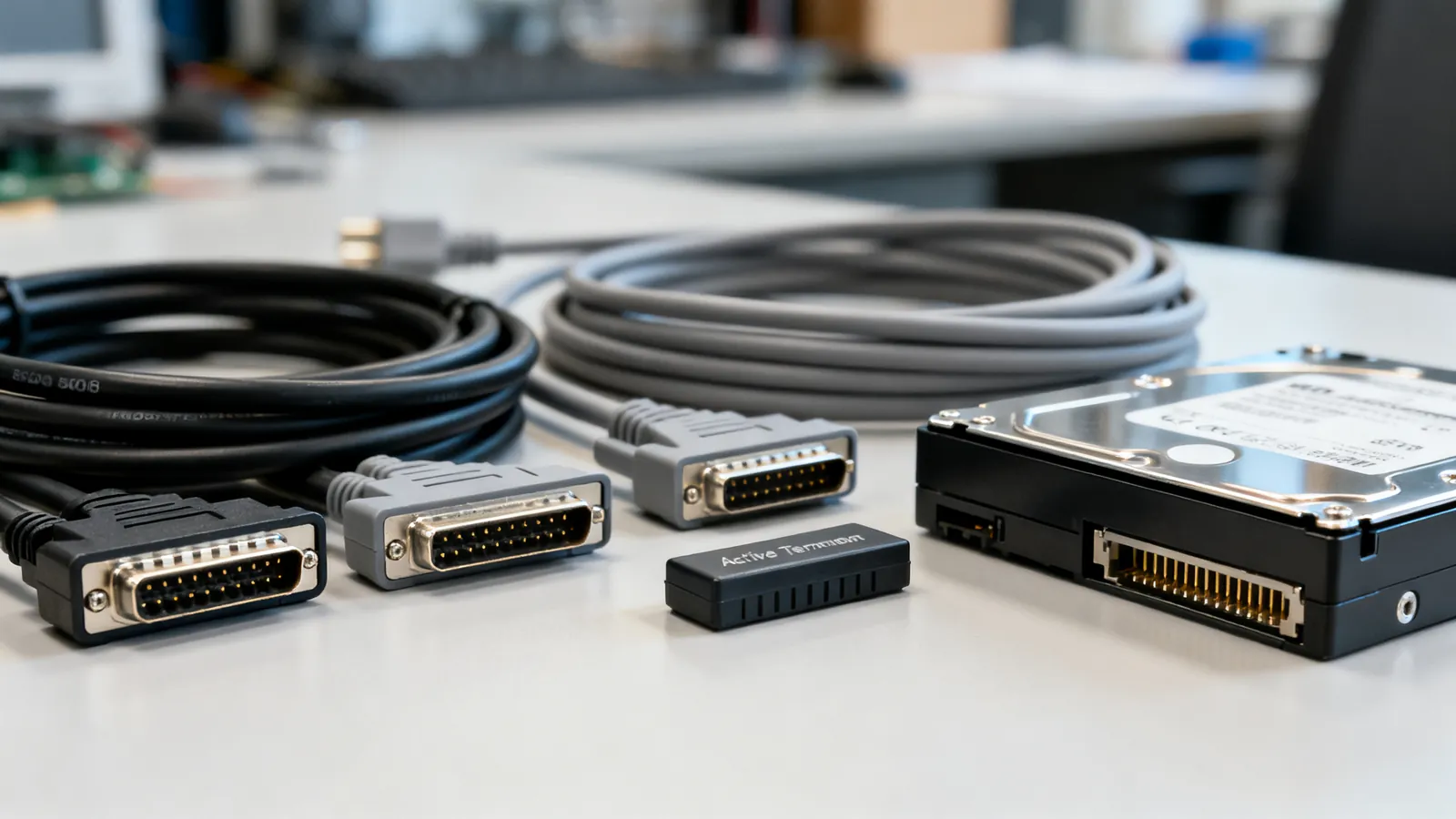
SCSI is a parallel bus, not a point-to-point link, and that single fact explains most of what goes wrong with it. Every device shares the same set of signal wires, the bus must be terminated at both physical ends, and each device needs its own address. Get any of those three wrong and the symptom is usually the same: the controller fails to see a drive, or the whole bus drops to the slowest device’s speed, or a scan hangs at boot.
The cable is the part people replace first, and often the wrong part. SCSI cable types are defined by width (how many data bits travel at once), by connector, and by the electrical signalling the bus uses. Those three things have to match the controller, the devices and the terminator.
Narrow and wide: how many bits, how many IDs
Narrow SCSI is an 8-bit bus. It uses 50-pin connectors and supports up to 8 IDs including the controller, so seven devices. Wide SCSI is a 16-bit bus, uses 68-pin connectors and supports up to 16 IDs, so fifteen devices. A wide controller can usually run narrow devices through an adapter, but the adapter has to handle termination correctly or the bus becomes unreliable.
| Bus width | Connector | IDs (including controller) | Typical use |
|---|---|---|---|
| Narrow, 8-bit | Centronics 50 external, IDC 50 internal, HD50 | 8 | Older scanners, tape drives, early disks |
| Wide, 16-bit | HD68 (VHDCI on many external controller ports) | 16 | Workstations, servers, RAID enclosures |
| SCA-80 | 80-pin hot-swap drive connector | 16 | Drive bays and backplanes |
The HD68 connector is the one most people meet on a wide controller or an external enclosure. It is a high-density 68-pin plug, and it is not the same as the 68-pin VHDCI connector used on some controller cards, which is smaller and needs its own cable. Buying the wrong one is a common and expensive mistake.
Speeds and the generations behind them
SCSI speed is quoted in megabytes per second, not gigabits, because it is a parallel bus clocked in step with the data. The generations ran Fast SCSI 10 MB/s, Fast Wide 20 MB/s, Ultra Wide 40 MB/s, Ultra2 Wide 80 MB/s, Ultra160 160 MB/s and Ultra320 320 MB/s. A cable rated for Ultra320 will run slower devices, but a cable rated only for Ultra Wide will not carry Ultra320 reliably, and the bus will negotiate down or produce errors.
SE, LVD and HVD: the rule that protects your hardware
Single-ended (SE) SCSI drives each signal against a common ground return. It is the oldest and shortest-reach form. Low voltage differential (LVD) drives each signal as a pair of opposing voltages, which cancels noise and allows longer buses. High voltage differential (HVD) does the same at much higher voltage swing, and it is the one that matters most here.
Never connect HVD devices to an SE or LVD bus. The voltage levels are incompatible and the attempt can destroy the SE or LVD transceivers. HVD equipment is rare, usually older and often marked clearly, but if a device’s signalling type is unknown, do not guess. LVD buses run up to 12 m (39 ft) with several devices, or 25 m (82 ft) point to point. SE buses are much shorter, around 3 m for Fast SCSI. If a bus is longer than its signalling allows, the usual result is intermittent errors under load, not a clean failure.
Termination: both ends, and only there
The SCSI bus is terminated at both physical ends and nowhere else. That means a terminator at the controller end and a terminator at the far end of the cable chain. If a device in the middle has its terminator enabled, the bus is terminated in three places and will misbehave. If neither end is terminated, the signals reflect and the bus is unreliable.
Active terminators are used on LVD and Ultra buses. They regulate the termination voltage rather than relying on a simple resistor, which matters as speeds rise. Passive terminators belong on older, slower SE buses only. A missing terminator often shows up as a device that appears during the controller’s scan but fails when data is written.
Cable length and device count
Length limits depend on the signalling type and how many devices are on the bus. LVD buses reach 12 m (39 ft) with several devices, or 25 m (82 ft) point to point. SE buses are much shorter, around 3 m for Fast SCSI. Adding devices shortens the usable length, and adding cable stubs off the main run makes it worse. Keep the chain as short and as straight as the installation allows.
What goes wrong, and what will not work
Mixing signalling types is the failure that damages hardware. HVD into SE or LVD can destroy transceivers, and there is no adapter that makes it safe.
Wrong terminator type is the most common fault. A passive terminator on an LVD bus, or an active terminator on an old SE bus, will cause errors that look like bad cables. Terminating the middle of the chain instead of the ends causes the same symptoms.
Duplicate SCSI IDs stop the bus working. Every device, including the controller, needs a unique ID, and the controller is usually ID 7 on narrow buses.
Using a narrow cable on a wide bus, or the reverse, without the correct adapter, either leaves half the data lines unconnected or shorts them. The adapter must also pass termination through correctly.
A cable rated below the bus speed will negotiate down or produce errors. Ultra320 cable on an Ultra160 bus is fine; the reverse is not.
If the equipment is being replaced rather than repaired, the modern equivalents are covered in SAS vs SATA cables and connectors, where the signalling is point-to-point and termination is not a user concern.
Practical checks before you buy
Confirm the bus width and connector on the controller. Confirm the signalling type (SE, LVD or HVD) on every device. Confirm the cable’s rated speed. Confirm where the two ends of the chain are, and that only those two points are terminated. If a device has a terminator jumper or switch, set it deliberately rather than leaving it at whatever it was when the drive was pulled from another machine.
For older serial equipment alongside SCSI, the pinouts are different and the voltage levels are not interchangeable; see RS-232 serial pinouts: DB9 and DB25 for the connector wiring on that side.
Common questions
What is a SCSI terminator and do I need one?
A terminator is a resistor network that absorbs signal reflections at the end of the SCSI bus. You need one at each physical end of the chain, and only there. Active terminators are used on LVD and Ultra buses; passive terminators belong on older, slower single-ended buses.
What is the difference between HD68 and 50-pin SCSI?
HD68 is the 68-pin high-density connector used on 16-bit wide SCSI buses, supporting up to 16 IDs. The 50-pin connectors (Centronics 50, IDC 50, HD50) are used on 8-bit narrow SCSI buses, supporting up to 8 IDs. They are not interchangeable without the correct adapter.
Can I mix LVD and SE SCSI devices on one bus?
LVD and SE devices can sometimes share a bus if the controller supports multimode and the bus is terminated correctly, but the whole bus drops to SE speed and length limits. HVD devices must never be connected to an SE or LVD bus, because the voltage levels are incompatible and can destroy the transceivers.
How long can a SCSI cable be?
It depends on the signalling type and device count. LVD buses run up to 12 m (39 ft) with several devices, or 25 m (82 ft) point to point. Single-ended buses are much shorter, around 3 m for Fast SCSI. Adding devices or cable stubs shortens the usable length.
Why does my SCSI bus only see some of the drives?
The usual causes are duplicate SCSI IDs, missing or misplaced termination, or a cable rated below the bus speed. Check that every device has a unique ID, that only the two ends of the chain are terminated, and that the cable matches the bus width and speed.
Read next
RS-232 Pinouts: DB9 and DB25 Explained
Complete RS-232 pinout reference for DB9 and DB25 connectors: DTE and DCE pin assignments, voltage levels, cable limits, and the TTL mistake that damages boards.
Null Modem Cables: Wiring, Adapters and Pinouts
A null modem cable crosses TX and RX to join two computers directly. Covers DB9 and DB25 pinouts, adapters versus cables, gender changers and loopback testing.
RS-422 vs RS-485: Differential Serial Compared
RS-422 is one driver to many receivers; RS-485 is a true multipoint bus. Compare distance, speed, termination and wiring, and see what damages hardware.