Speaker Wire Gauge: Choosing the Right AWG
How to choose speaker wire gauge by run length and speaker impedance, plus in-wall CL2 vs CL3 ratings, connectors and polarity. 14 vs 16 AWG explained.
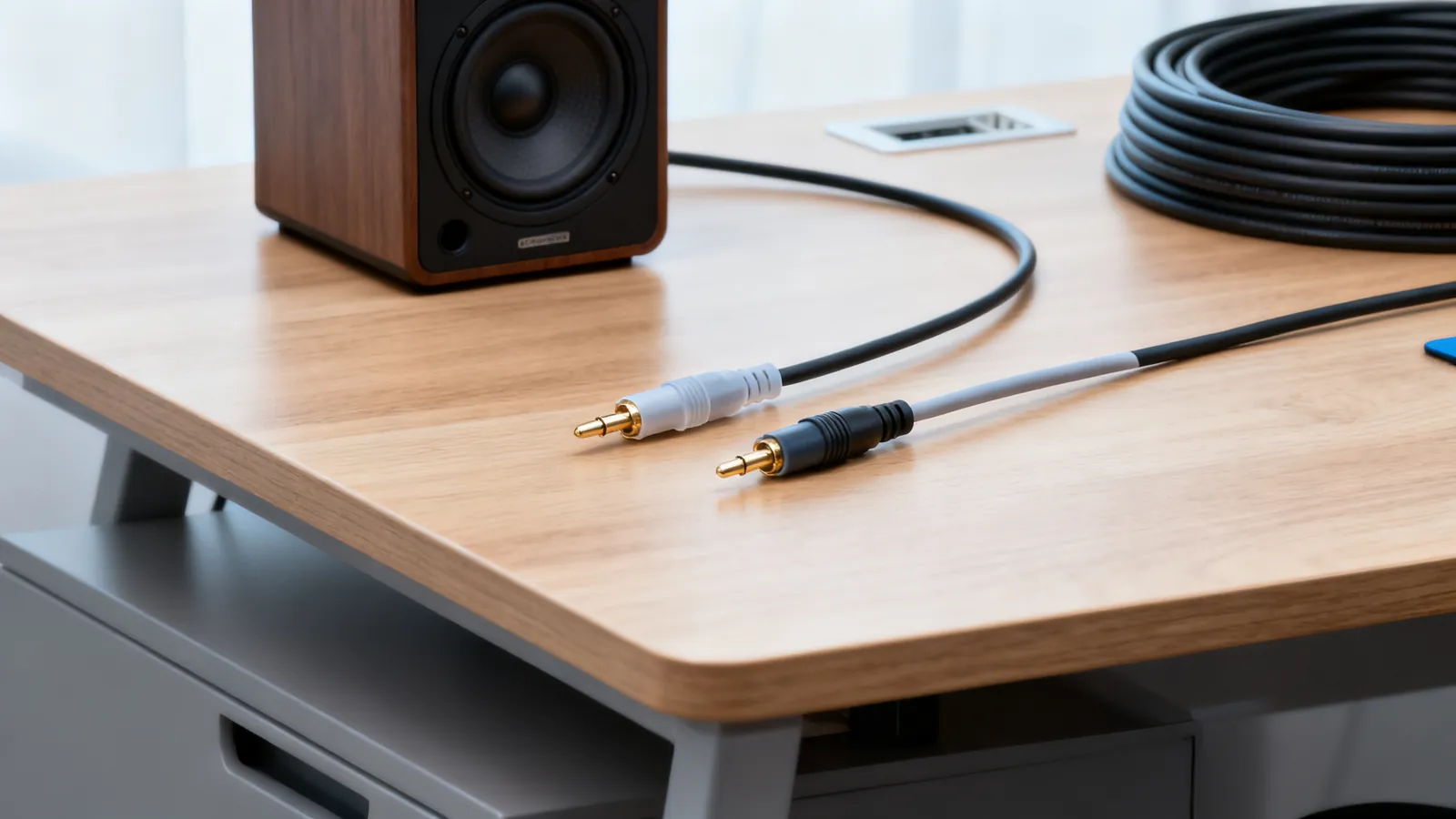
Speaker wire gauge is chosen by matching the wire’s resistance to the run length and the speaker’s impedance: 16 AWG suits typical home runs, 14 AWG is for longer runs or 4 ohm speakers, and 12 AWG is for long runs. A lower AWG number is a thicker wire, and thicker wire loses less signal over distance. The practical decision is about resistance, not about exotic materials or marketing claims.
How gauge, length and impedance interact
Every speaker cable has resistance, and that resistance is a fraction of the speaker’s impedance. The lower the speaker impedance, the more a given length of wire matters. Speaker impedance is commonly 4, 6 or 8 ohm. A 4 ohm speaker draws more current for the same voltage, so the cable’s resistance becomes a larger share of the total load, and the amplifier has to work against it.
Length matters because resistance rises with distance. A short run of thin wire can be fine; the same wire over a long run is not. The rule of thumb is to keep the total resistance of the cable low relative to the speaker impedance, so the amplifier’s damping and the frequency response stay predictable.
| Gauge | Typical use |
|---|---|
| 16 AWG | Typical home runs |
| 14 AWG | Longer runs, or 4 ohm speakers |
| 12 AWG | Long runs |
If the run is short and the speaker is 8 ohm, 16 AWG is usually enough. If the run is long, or the speaker is 4 ohm, step up to 14 AWG. For very long runs, 12 AWG. The exact crossover point depends on the amplifier and the speaker, but the direction is always the same: longer run or lower impedance means thicker wire.
Why 14 vs 16 gauge is the common question
14 AWG and 16 AWG are the two sizes most home installations use. The difference is resistance per unit length: 14 AWG is thicker and has lower resistance, so it holds the signal better over distance. For a typical living-room run, 16 AWG is adequate. For a run to another room, or for a 4 ohm speaker, 14 AWG is the safer choice. The cost difference is small, and the installation effort is the same.
In-wall speaker wire: CL2 vs CL3
Speaker wire run inside a wall should be rated CL2 or CL3. These are fire ratings for the jacket, not electrical ratings. CL2 is the general-purpose in-wall rating; CL3 is a higher rating for the same kind of use. A higher rating can replace a lower one, so CL3 can be used where CL2 is required, but not the reverse.
In-wall cable is also made with a jacket that resists abrasion and the conditions inside a wall cavity. Ordinary zip cord is not rated for in-wall use, even if it is the right gauge. If the cable runs through an air-handling space, the rating requirements are stricter, and a plenum-rated cable is needed. Mains power cabling inside walls is a job for a licensed electrician; keep communications and speaker cable separated from mains conductors, and cross them at a right angle where they must cross.
Connectors and polarity
Speaker connections are simple, but polarity matters. The two conductors in a speaker cable are marked so you can keep the positive and negative terminals consistent at both ends. Common markings are a stripe on one conductor, a rib, or different colours under the jacket. If the polarity is reversed at one end, the speakers are out of phase: bass cancels and the stereo image collapses.
Common terminations are bare wire, banana plugs, spade connectors and pin connectors. Bare wire is fine if the strands are tidy and no stray strand bridges the two terminals. Banana plugs make repeated connections easier and reduce the chance of a short. Spade connectors suit binding posts that clamp. Whatever the connector, the goal is a firm, clean contact with no stray strands.
For line-level audio between equipment, the connector types and their balanced or unbalanced nature are covered in audio cable types: XLR, TRS, TS, RCA and 3.5 mm. Speaker-level cable is a different job: it carries power to the speaker, not a low-level signal.
What goes wrong
- Too thin for the run. A long run of thin wire adds resistance, which reduces the power delivered to the speaker and can shift the frequency response. The fix is a thicker gauge, not a different connector.
- Reversed polarity. One speaker wired backwards puts the pair out of phase. Check the markings at both ends.
- Stray strands. A single strand bridging the positive and negative terminals can short the amplifier. Trim and twist the strands before inserting them.
- Wrong jacket for the location. Ordinary zip cord in a wall is not rated for the location. Use CL2 or CL3 cable for in-wall runs.
- Assuming thicker is always better. Very thick wire is harder to terminate and can be unnecessary for a short run. Match the gauge to the run and the impedance.
Choosing the right gauge in practice
Start with the speaker impedance and the run length. For an 8 ohm speaker on a typical home run, 16 AWG is usually enough. For a 4 ohm speaker, or a longer run, use 14 AWG. For a long run, use 12 AWG. If the cable goes inside a wall, choose a CL2 or CL3 rated cable in the gauge you need.
Keep the two conductors together as a pair; do not separate them more than necessary. Keep speaker cable away from mains power cables, and cross them at a right angle if they must cross. Label both ends so the polarity is obvious at the amplifier and at the speaker.
For coaxial cable used for TV, satellite or antennas, the choice is different: RG6 vs RG59 coax cable covers the 75 ohm coax types and where each is used. Speaker wire is not coax, and the two are not interchangeable.
A note on materials
Copper is the conductor to use. Copper-clad aluminium has higher resistance and is brittle when flexed, and it is not a substitute for copper in a speaker run. If the cable is advertised by a fancy name rather than by gauge and copper content, look for the gauge and the conductor material.
Length and resistance in words
A short run of 16 AWG can be perfectly adequate, while the same wire over a much longer run is not. The exact length at which you should step up depends on the speaker impedance and the amplifier, but the principle is fixed: as the run gets longer, or the impedance gets lower, the wire needs to be thicker. If in doubt, go one gauge thicker; the cost is small and the margin is useful.
Common questions
Is 14 or 16 gauge speaker wire better?
It depends on the run length and the speaker impedance. 16 AWG is usually enough for a typical home run with an 8 ohm speaker. 14 AWG is the safer choice for longer runs or for 4 ohm speakers, because it has lower resistance.
Can I use ordinary speaker wire inside a wall?
No. In-wall speaker wire should be rated CL2 or CL3. These are fire ratings for the jacket. Ordinary zip cord is not rated for in-wall use, even if the gauge is correct.
What is the difference between CL2 and CL3 speaker wire?
CL2 and CL3 are fire ratings for the cable jacket. CL3 is a higher rating, and a higher-rated cable can be used where a lower one is required. CL2 is the general-purpose in-wall rating.
Does speaker wire length affect sound quality?
Yes, because resistance rises with length. A long run of thin wire adds resistance, which reduces the power delivered to the speaker and can shift the frequency response. Use a thicker gauge for longer runs.
What happens if I reverse speaker wire polarity?
If one speaker is wired backwards, the pair is out of phase. Bass cancels and the stereo image collapses. Keep the marked conductor on the same terminal at both the amplifier and the speaker.
Read next
Composite vs Component Video: RCA Cables Compared
Composite and component video both use RCA plugs, but carry different signals. Compare resolution, connectors, S-Video and SCART, and adapters for old gear.
Audio Cable Types: XLR, TRS, TS, RCA and 3.5 mm
XLR, TRS, TS, RCA and 3.5 mm audio cables compared: what each carries, balanced vs unbalanced wiring, line levels, TRRS pin orders and which adapters work.
BNC Connectors and SDI Video Cables: 50 vs 75 Ohm
BNC connectors come in 50 and 75 ohm versions. Learn which to use for SDI video, CCTV and test gear, the SDI data rates, and how to convert BNC to RCA.
DisplayPort 1.2, 1.4 and 2.1: Versions and Cables
DisplayPort 1.2, 1.4 and 2.1 compared: bandwidth, DSC, MST, DP40 and DP80 cable certification, and DisplayPort over USB-C.
Long HDMI Runs: Active, Fiber and HDBaseT
Why long passive HDMI cables fail, how active copper and fiber HDMI cables work, and when HDBaseT over category cable is the right answer for a long run.