IEC Power Cord Types: C13, C5, C7 and C19
IEC 60320 couplers explained: C13 vs C14, C5 cloverleaf, C7 figure 8 and C19/C20. Ratings, plug ends, and how to pick a safe replacement cord.
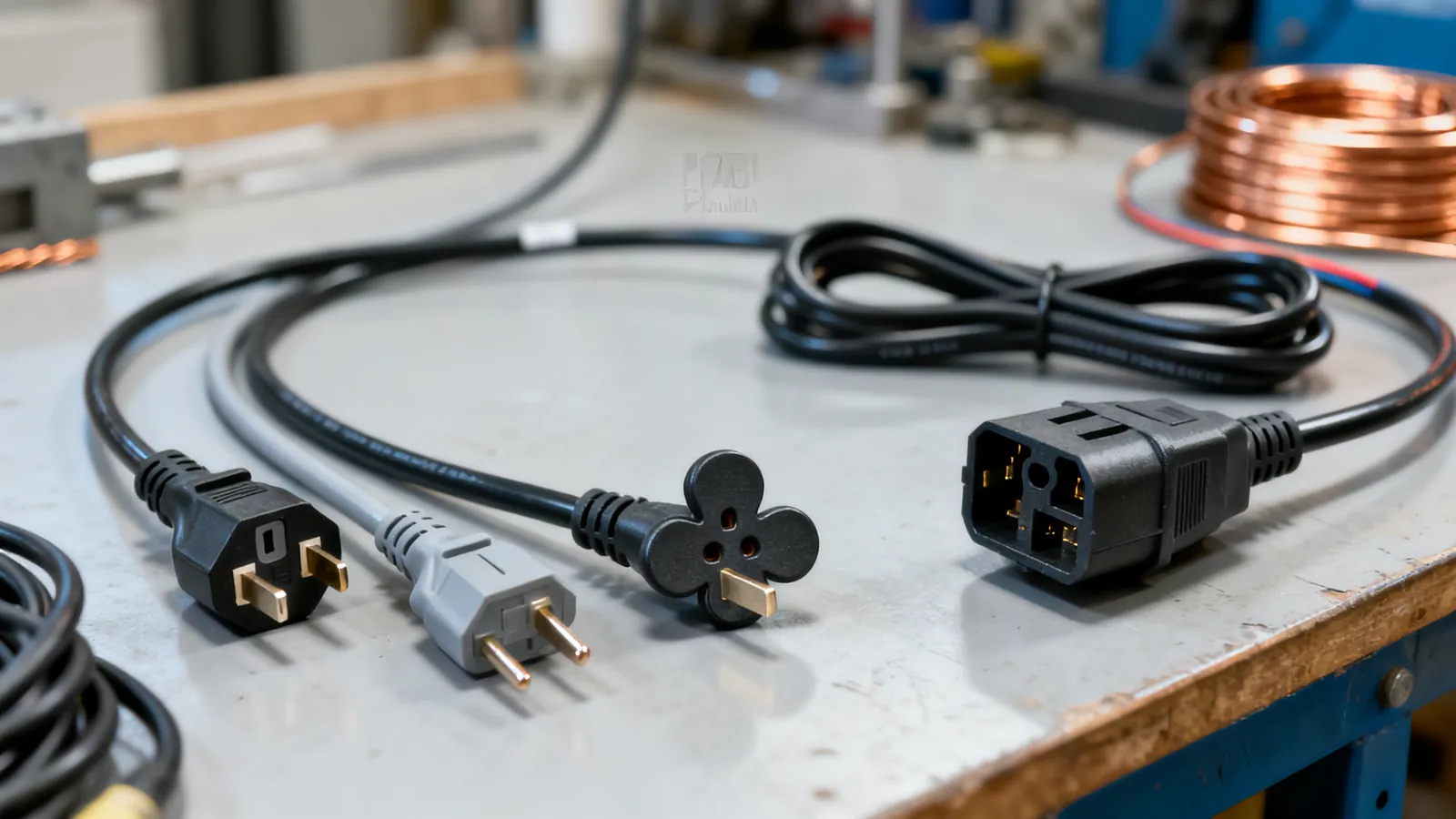
An IEC power cord is a length of mains cable with a standard coupler on the equipment end and a wall plug on the other. The coupler family is IEC 60320, and the two names people mix up most are C13 and C14: the C13 is the cable connector, the C14 is the matching inlet on the device. A cord with a C13 end plugs into any device with a C14 inlet. The same logic runs through the whole family - C5, C7, C19 and C20 are all defined by which half is the cable and which half is the appliance.
The IEC 60320 coupler family
IEC 60320 defines appliance couplers in pairs: a cable-mounted connector and a device-mounted inlet. The connector is the half on the cord; the inlet is the half built into the equipment. Ratings below are the standard’s, with North American UL ratings in brackets where they differ.
| Coupler | Common name | Typical use | Current rating |
|---|---|---|---|
| C13 into C14 | IEC cord, kettle lead | Computers, monitors, servers, PDUs | 10 A (15 A UL) |
| C5 into C6 | Cloverleaf | Laptop power bricks, some projectors | 2.5 A |
| C7 into C8 | Figure 8, shotgun | Small electronics, radios, some TVs | 2.5 A |
| C15 into C16 | Hot-condition C13 | Kettles, urns, appliances that run hot | 10 A, rated 120 °C |
| C19 into C20 | High-current IEC | Servers, UPSs, PDUs, larger switches | 16 A (20 A UL) |
IEC couplers are rated 250 V. Mains voltage itself is 120 V in North America and 230 V in most of Europe; the coupler rating covers both.
C13 and C14
The C13 connector has three rectangular contacts in a row inside a rectangular shroud. Its inlet is the C14, the familiar three-pin socket on the back of a desktop computer, monitor, switch or rack PDU. This is the cord most people mean when they say “IEC power cord”. The C13/C14 pair is rated 10 A under IEC 60320, and 15 A under North American UL ratings.
C5 and the cloverleaf
The C5 connector has three round contacts arranged in a triangle inside a shape that gives it the name cloverleaf. Its inlet is the C6. It appears on laptop power bricks, some projectors and a few small appliances. The C5 is rated 2.5 A, so it is not a substitute for a C13 where the device draws more.
C7 and the figure 8
The C7 connector has two contacts in a flattened figure-eight outline. Its inlet is the C8. It is ungrounded - two conductors only - and rated 2.5 A. It appears on radios, small power supplies, some TVs and similar low-power electronics. The C7 comes in a polarized and a non-polarized version; the polarized one has a squared-off side so it only fits one way.
C15 and C16
The C15 looks like a C13 with a notch cut into the shroud, and it mates with a C16 inlet. The notch lets it fit a hot appliance where a plain C13 would be blocked or would soften. It is rated for 120 °C. A C15 cord will fit a C14 inlet; a C13 cord will not fit a C16 inlet.
C19 and C20
The C19 connector is larger, with three horizontal blade contacts, and mates with the C20 inlet. It is rated 16 A under IEC 60320 and 20 A under UL. It appears on servers, UPSs, rack PDUs and larger network gear that draws more than a C13 link should carry. C19 and C13 are not interchangeable in either direction - the shapes and the current ratings are different.
Which cord fits which device
Match the coupler to the inlet first, then match the current rating to the device. The inlet on the equipment tells you the family; the current marked on the device tells you whether a 2.5 A cord is enough or whether the link needs a 10 A or 16 A coupler.
| Device | Inlet | Cord connector |
|---|---|---|
| Desktop PC, monitor, switch | C14 | C13 |
| Laptop power brick | C6 | C5 |
| Small radio, set-top box | C8 | C7 |
| Rack server, UPS, PDU | C20 | C19 |
A replacement cord must match the inlet and meet or exceed the current marked on the device. A cord rated below the device’s draw will run warm and is the wrong part. Length matters too: a longer cord adds resistance, and a coiled or tightly bundled cord under load runs hotter than a straight one.
Wall plug ends
The equipment end is standardised by IEC 60320; the wall end is regional. In North America the common plug is NEMA 5-15, grounded, rated 15 A at 125 V. The older NEMA 1-15 is the two-prong ungrounded plug. In Europe the wall end varies by country, and cords are sold with the plug for the country of use. A cord with the wrong wall plug for the region is not usable, and adapters that change the plug shape do not change the voltage or the current rating.
Choosing a safe replacement cord
Read the inlet on the device and the current marking near it. Buy a cord whose coupler matches the inlet and whose rating is at least the device’s current. Check that the wall plug matches the outlet in the region. For equipment in a rack, keep cord lengths sensible so airflow is not blocked and so cords are not pinched at the rack door.
Wiring or repairing a mains plug or cord is not a job for a cable reference. Replace the cord, or ask a licensed electrician. Mains work inside walls, at outlets or at a plug is out of scope here.
What goes wrong
C13 and C19 mixed up. They do not fit each other, and forcing one damages the inlet. If a cord will not seat, it is the wrong coupler.
C5 or C7 used where a C13 belongs. The 2.5 A rating is the limit. A C5 or C7 cord on a device that draws more than that will run hot and is unsafe.
C13 used on a hot appliance. A C16 inlet expects a C15 cord. A plain C13 may not seat or may soften against a hot inlet.
Wrong wall plug for the region. A cord with a European wall plug will not fit a North American outlet, and a plug adapter does not change the rating.
Cord rated below the device. A cord must meet or exceed the current marked on the device. A lower-rated cord is the wrong part, not a spare.
Damaged or repaired cords. A cord with a cut jacket, a bent contact or a taped repair should be replaced, not used. Repairing a mains cord is a job for a licensed electrician.
Cords bundled under load. Coiling a cord tightly or bundling several together traps heat. Run cords straight where practical.
Where power cords sit in a system
Power cords are one part of the cabling behind a desk, a rack or an AV install. Signal cabling is separate: audio cable types such as XLR, TRS, TS, RCA and 3.5 mm cover the balanced and unbalanced lines between sources and amplifiers, and planning a wired home network covers the data cabling that runs alongside power but must be separated from it. The NEC asks for at least 50 mm (2 in) between communications cable and mains power conductors unless a barrier separates them, and power cables should cross data cables at a right angle.
Quick reference
- C13 into C14: computers, monitors, servers, PDUs; 10 A (15 A UL).
- C5 into C6: cloverleaf; laptop bricks, projectors; 2.5 A.
- C7 into C8: figure 8; small electronics; 2.5 A, ungrounded.
- C15 into C16: hot-condition C13; 10 A, rated 120 °C.
- C19 into C20: servers, UPSs, PDUs; 16 A (20 A UL).
- IEC couplers are rated 250 V; wall ends are regional (NEMA 5-15 in North America, country-specific in Europe).
- A replacement cord must match the inlet and at least the current marked on the device.
- Mains wiring and cord repair are jobs for a licensed electrician.
Common questions
What is the difference between C13 and C14?
C13 is the connector on the cable; C14 is the inlet on the device. A C13 cord plugs into a C14 inlet. The pair is rated 10 A under IEC 60320 and 15 A under North American UL ratings, and appears on computers, monitors, servers and PDUs.
What is a cloverleaf power cord used for?
The cloverleaf is the C5 connector, which mates with a C6 inlet. It appears on laptop power bricks, some projectors and a few small appliances. It is rated 2.5 A, so it is not a substitute for a C13 where the device draws more.
Is a figure 8 cord the same as a C7?
Yes. The figure 8 is the C7 connector, which mates with a C8 inlet. It has two contacts, is ungrounded, and is rated 2.5 A. It appears on radios, small power supplies and some TVs. A polarized version fits only one way.
Can I use a C13 cord on a C19 inlet?
No. C19 and C13 are different shapes and different ratings - C19 is 16 A under IEC 60320 and 20 A under UL, while C13 is 10 A (15 A UL). Forcing one damages the inlet. Match the coupler to the inlet.
How do I choose a replacement power cord?
Read the inlet on the device and the current marking near it. Buy a cord whose coupler matches the inlet and whose rating is at least the device's current, with a wall plug that matches the outlet in the region. Wiring or repairing a mains plug or cord is a job for a licensed electrician.
Read next
Audio Cable Types: XLR, TRS, TS, RCA and 3.5 mm
XLR, TRS, TS, RCA and 3.5 mm audio cables compared: what each carries, balanced vs unbalanced wiring, line levels, TRRS pin orders and which adapters work.
Composite vs Component Video: RCA Cables Compared
Composite and component video both use RCA plugs, but carry different signals. Compare resolution, connectors, S-Video and SCART, and adapters for old gear.
BNC Connectors and SDI Video Cables: 50 vs 75 Ohm
BNC connectors come in 50 and 75 ohm versions. Learn which to use for SDI video, CCTV and test gear, the SDI data rates, and how to convert BNC to RCA.