Shielded vs Unshielded Ethernet: UTP, FTP, STP
UTP, FTP, S/FTP and STP decoded: what shielding does, when it helps, and why a shield that is not grounded end to end gives no benefit.
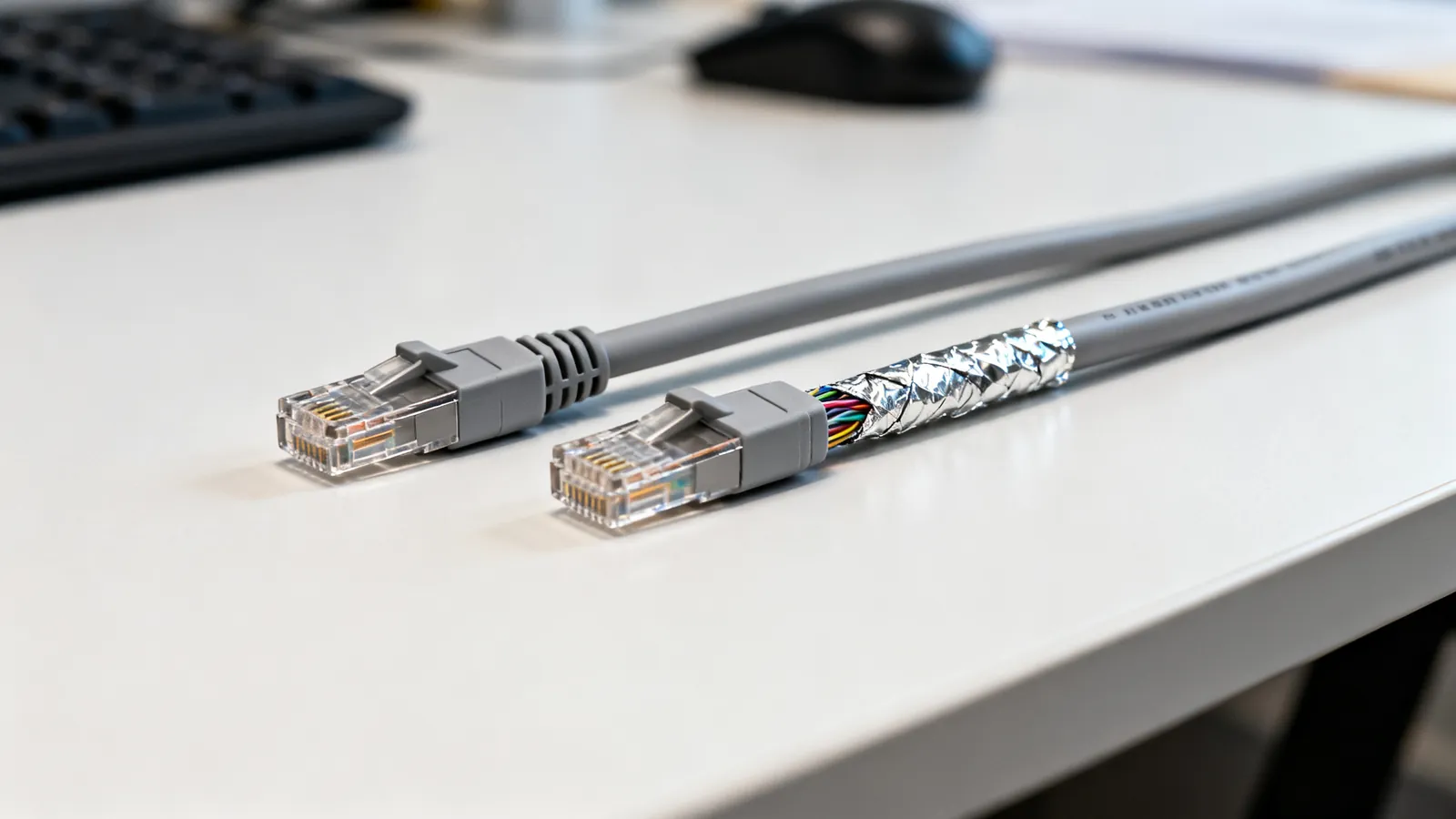
Shielded and unshielded Ethernet cable carry the same signal on the same four twisted pairs. The difference is a conductive layer around the pairs, and that layer only does anything when it is bonded to ground at both ends through shielded jacks, plugs and patch panels. In a normal home or office run, unshielded twisted pair (UTP) is the correct choice; shielding is for specific environments and must be installed as a complete system.
What the ISO names actually mean
ISO/IEC 11801 writes shielding as two letters separated by a slash: the first is the overall screen, the second is the screen on each pair. TP means twisted pair.
| ISO name | Overall screen | Pair screen | Common label |
|---|---|---|---|
| U/UTP | none | none | UTP, unshielded |
| F/UTP | foil around all pairs | none | FTP, often sold as “STP” |
| U/FTP | none | foil on each pair | pair-shielded |
| S/FTP | braid overall | foil on each pair | S/FTP, sometimes “STP” |
So “STP” on a product page is not a standard name. It usually means F/UTP or S/FTP. The letters tell you what is actually inside the jacket.
When shielding helps
A screen blocks electrical noise from outside the cable and reduces what the pairs radiate. That matters in a few places:
- Industrial areas with motors, drives and welding equipment.
- Cable trays shared with power conductors, or runs close to variable-frequency drives.
- Data centres where many cables are bundled tightly and alien crosstalk between them is the limit.
- Sites with a documented electromagnetic-compatibility requirement.
In a house or a small office, the noise sources are usually not strong enough to break a link. The bigger risks are poor terminations, long runs and cheap cable, not the absence of a shield.
What a shielded run needs end to end
A shield is a continuous conductor. If it is broken anywhere, or left floating, it does not block noise and can act as an antenna that couples noise into the pairs. A working shielded channel needs:
- Shielded cable throughout, with no unshielded patch cords.
- Shielded jacks, plugs and patch panels.
- The shield bonded to ground at the equipment, through the panel and the jack.
- The same grounding practice at both ends of the channel.
Mixing shielded cable with unshielded patch cords, or with an unshielded patch panel, breaks the path and gives no benefit. In many small installations the shield is simply not terminated, which is worse than using UTP from the start.
Which category to pair with which shield
Shielding is independent of category. Cat5e, Cat6 and Cat6a are all available shielded and unshielded, and the speed and distance limits do not change because of the shield. Cat6 is rated to 250 MHz and carries 10GBASE-T up to 55 m (180 ft), and as little as 37 m (121 ft) where many cables run bundled together. Cat6a is rated to 500 MHz and carries 10 Gbps to the full 100 m (328 ft). The 100 m (328 ft) channel is up to 90 m (295 ft) of permanent link plus up to 10 m (33 ft) of patch and equipment cords. If you are choosing a category, see Cat5e vs Cat6 vs Cat6a: which one to buy.
Shielded Cat6a is the usual choice where shielding is required, because the higher frequency and tighter bundling make crosstalk the limiting factor. For a single run in a home, unshielded Cat6 or Cat6a is simpler and performs the same at the speeds involved.
Do you need shielded Cat6?
Ask three questions:
- Is there a known noise source near the cable, such as a drive or a motor?
- Will the cable share a path with power conductors for a long distance?
- Is there a specification or contract that requires shielded cable?
If the answer to all three is no, unshielded cable is the right choice. If any answer is yes, plan a full shielded system, including the patch panel, jacks and cords, and confirm how the shield will be grounded. A shield that is not grounded does nothing.
Conductors, jackets and the rest of the cable
Shielding is only one part of the construction. The conductors should be solid copper for horizontal runs and stranded copper for patch cords. Copper-clad aluminium (CCA) does not meet TIA category standards: it has higher resistance, is brittle when flexed and runs hotter under PoE. Category cable is solid or stranded copper.
For runs inside walls, the jacket fire rating matters more than the shield. In the US, NEC ratings are CMP (plenum), CMR (riser), CM or CMG (general purpose) and CMX (limited residential). A higher rating can replace a lower one. In the EU, cable fire performance is classed under the Construction Products Regulation with Euroclasses such as Eca, Dca, Cca and B2ca, and LSZH jackets are common. Outdoor cable needs a UV-resistant jacket, and direct-burial cable is gel-filled or flooded; indoor cable is not rated for either. Mains work is a job for a licensed electrician, and the NEC asks for at least 50 mm (2 in) between communications cable and mains power conductors unless a barrier separates them.
What goes wrong
- A shield that is not grounded. It provides no protection and can pick up noise. If you cannot ground it properly at both ends, use UTP.
- Mixing shielded and unshielded parts. One unshielded patch cord breaks the shield path for the whole channel.
- Buying “STP” without checking the letters. The cable may be F/UTP or S/FTP, and the jacks and panels must match.
- Assuming shielding raises the speed. It does not. Cat6 shielded still carries 10GBASE-T up to 55 m (180 ft), and Cat6a shielded still carries it to 100 m (328 ft).
- Ignoring the 100 m channel. The limit applies to every speed from 10 Mbps to 10 Gbps on the matching category, and it is set by signal loss and timing, not by the shield.
- Using CCA cable. It does not meet the category standards and should never carry PoE.
- Long untwisted ends. Pair untwist at a termination must be no more than 13 mm (0.5 in) for Cat5e and higher.
- Tight bends and hard pulls. Installed bend radius for 4-pair UTP is at least 4 times the cable’s outside diameter, and maximum pulling tension is 25 lbf (110 N).
Testing and labelling
A continuity or wiremap tester finds opens, shorts, crossed wires and reversed pairs. Split pairs pass a simple continuity test and need a tester that measures crosstalk. Qualification testers check whether a link carries a given speed. Certification testers measure the link against the TIA category limits, which is the only way to prove a link meets Cat6 or Cat6a. A TDR shows the distance to a fault. Label both ends of every cable, following ANSI/TIA-606.
Choosing in practice
For a home, a small office or a typical commercial fit-out, unshielded Cat6 or Cat6a is the standard answer. It is easier to terminate, needs no grounding plan and meets the same speed and distance limits. Choose shielded cable when there is a real noise source, a shared path with power, or a specification that demands it, and then install it as a complete shielded system. If you are still deciding on a category, the Ethernet cable categories explained: Cat5e to Cat8 page sets out the frequency ratings and the speeds each one supports.
Common questions
Do I need shielded Cat6 cable at home?
Usually no. Homes rarely have strong electrical noise near the cable, and unshielded Cat6 carries 1 Gbps to 100 m (328 ft) and 10GBASE-T up to 55 m (180 ft). Shielding only helps if it is grounded end to end, which needs shielded jacks, plugs and a patch panel.
What is the difference between STP and UTP?
UTP is unshielded twisted pair: four pairs, no screen. STP is not a standard name; it usually means F/UTP (foil around all pairs) or S/FTP (braid overall plus foil on each pair). The letters in the ISO name tell you what is actually inside the jacket.
Does shielded cable give faster speeds?
No. The shield does not change the category rating. Cat6 is rated to 250 MHz and Cat6a to 500 MHz whether shielded or not, and the 100 m (328 ft) channel limit applies to both.
Can I mix shielded and unshielded patch cords?
You can plug them in, but the shield path is broken, so the shielded cable gives no benefit. A shielded system needs shielded cable, jacks, plugs and patch panels throughout, with the shield bonded to ground at both ends.
What happens if the shield is not grounded?
An ungrounded shield does not block noise and can act as an antenna that couples noise into the pairs. If you cannot ground the shield properly at both ends, use unshielded cable instead.
Read next
Ethernet Cable Categories: Cat5e to Cat8
Ethernet cable categories compared: Cat5e, Cat6, Cat6a, Cat7 and Cat8 rated frequency, speed and distance, plus which to buy for home, office and 10 Gbps.
Cat5e vs Cat6 vs Cat6a: Which Ethernet Cable to Buy
Cat5e, Cat6 and Cat6a compared: bandwidth, 10 Gbps reach, shielding and when each category is the right choice for home or office cabling.
Crossover vs Straight-Through Ethernet Cables
Crossover or straight-through? How T568A and T568B pinouts decide it, why Auto-MDI-X made crossovers rare, and when a rollover console cable is still needed.
Fiber vs Copper Ethernet: When Fiber Makes Sense
Fiber vs copper Ethernet compared: distance, interference, lightning between buildings, speed headroom, and the handling trade-offs against Cat6 and Cat6a.
Fiber Optic Cable Types: Singlemode and Multimode
Singlemode and multimode fiber compared: OS2, OM1 to OM5, jacket colours, reach at 1G, 10G, 40G and 100G, and how to choose for a building or campus.